ASI and SoftBank Group Accelerate Autonomous Construction with $225 Million Investment
12 October 2026 | Interaction | By Editor Robotics Business NEWS <editor@rbnpress.com>
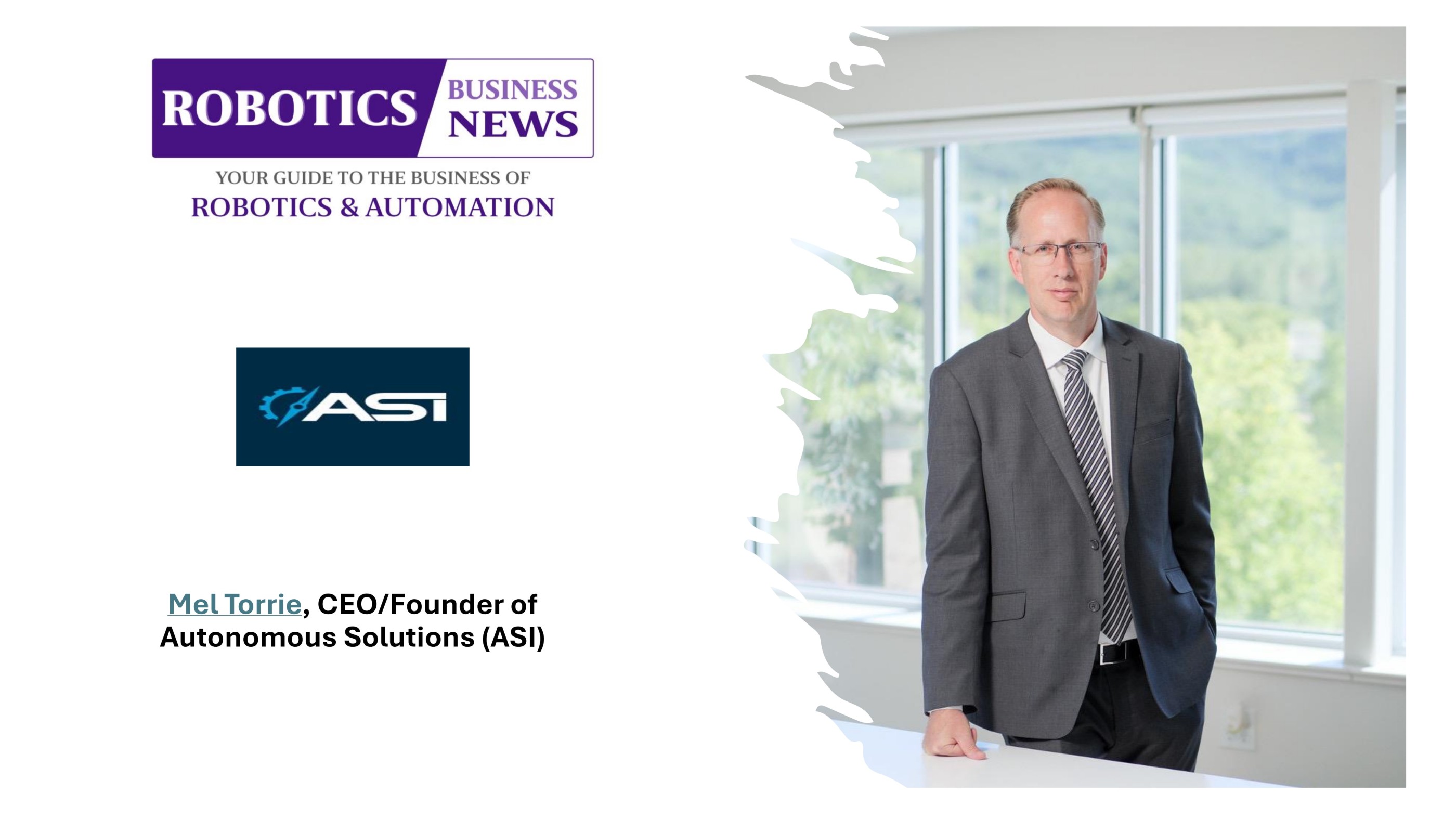
Autonomous Solutions, Inc. CEO Mel Torrie discusses fleet orchestration, mixed-fleet automation and scaling autonomous equipment across major infrastructure projects.
Robotics Business News spoke with Mel Torrie, CEO of Autonomous Solutions, Inc. (ASI), about the company’s joint venture with SoftBank Group and its strategy for scaling autonomous construction. Torrie explains how ASI’s Mobius platform coordinates mixed fleets of heavy equipment, including haul trucks, loaders, dozers and compactors, to automate complex construction workflows.
The conversation explores how fleet orchestration, AI, real-time decision-making and OEM-agnostic technology can help address labor shortages and improve coordination across major infrastructure projects. Torrie also discusses how SoftBank Group’s $225 million investment will support platform development, commercial expansion and larger autonomous deployments across construction and related industries.
What was the strategic vision behind ASI and SoftBank Group forming a joint venture, and why is this the right time to scale autonomous construction?
"We've spent more than twenty-five years building Mobius because we believed the industry's autonomy problem was never really about any single vehicle. It’s been about coordinating entire fleets, across brands, on live jobsites, at scale. SoftBank Group brings significant capital and a shared conviction that autonomous construction is at an inflection point. Demand for large infrastructure, like roads, airports, rail, and waste management, is accelerating faster than the skilled labor pool can keep pace with, and the equipment-coordination problem at scale hasn't been solved by anyone else in production today. The timing is right because the technology has matured past pilots. ASI is already orchestrating industrial autonomous fleet orchestration of mixed vehicle types and fleets in live deployments right now, and this joint venture gives us the capital to bring that proven capability to the scale this moment actually demands, rather than scaling it slowly on our own timeline."
How will the joint venture accelerate the commercialization of autonomous construction equipment for large infrastructure projects?
" Commercialization at scale has always come down to two things: a platform that actually works in the field, and the capital to deploy it broadly. We have the first part today with ASI’s Mobius®. And to be clear, this is bigger than a software platform — Mobius® is a complete fleet automation and optimization solution that rolls up under Mobius AI, combining OEM-agnostic hardware kits, site infrastructure, and the mobile tools operators actually use, not just a management dashboard bolted onto someone else’s equipment. A lot of companies have tried to sell fleet management software, or just a retrofit kit, without the other vital pieces it actually takes to run a site autonomously. We built the whole solution, not one piece of it. Mobius has been proven across mixed fleets of haul trucks, loaders, dozers, and compactors. This joint venture adds the capital and partnership to take that proven capability from individual deployments to a repeatable, scalable commercial model across civil construction and other adjacent applications. That means faster customer onboarding, more resources dedicated to adapting the platform for new equipment types and site conditions, and the ability to pursue larger, more complex infrastructure projects than we could take on independently. We're not starting from a research position. ASI is accelerating something that already works."
ASI's Mobius platform is designed for mixed fleets. How does OEM-agnostic fleet orchestration help construction companies deploy multiple types of autonomous equipment together?
"Most autonomy solutions in this industry are built around a single vehicle or a single manufacturer's closed ecosystem, which means a customer who wants to automate their site is locked into one brand, or stuck bolting together incompatible point solutions. Mobius was built the opposite way: as an orchestration layer that sits above the equipment itself, so a haul truck from one manufacturer, a dozer from another, and a loader from a third can all operate autonomously together, coordinated as a single fleet rather than as isolated machines. For a construction company, that means you can automate the equipment you already own, add new machines from whatever brand makes sense for the job, and avoid being locked into one OEM's roadmap or pricing. It also means the system can actually orchestrate a real jobsite by sequencing tasks, avoiding conflicts, and adapting across a mixed fleet instead of automating one vehicle type in isolation and leaving the rest of the site unchanged."
What are the biggest technical and operational challenges involved in making heavy construction equipment operate autonomously across complex jobsites?
" The hardest problems aren't about getting one machine to drive itself. Plenty of companies have done that. They show up when you try to get many different machines, from different manufacturers, with different control systems and sensor suites, to operate safely together on a constantly changing site. A jobsite isn't a controlled environment: terrain shifts, weather changes, material piles move, and human workers and other equipment are present and unpredictable. That means the system must make real-time decisions at the fleet level, not just the vehicle level, replanning instantly when something changes, rather than following a fixed path. Safety assurance in that kind of dynamic, shared environment is a serious engineering challenge, as is maintaining reliable connectivity on remote or infrastructure-poor sites where cellular or network coverage can't be assumed. And because the industry is still maturing its regulatory and certification pathways for autonomous heavy equipment, building systems that are both field-proven and ready for evolving standards is an ongoing challenge every serious player in this space has to solve for, not a one-time hurdle."
How can autonomous haul trucks, dozers, loaders, and compactors work together to automate end-to-end construction workflows?
" On a real jobsite, no single machine completes a job on its own. Instead, material gets excavated, loaded, hauled, placed, graded, and compacted, often simultaneously, by different equipment types working in sequence. ASI’s Mobius orchestrates the whole workflow as one system: loaders and excavators stage material, haul trucks move it, dozers grade it, and compactors finish it, with the orchestration layer sequencing tasks, routing vehicles to avoid collisions, and adjusting in real time as site conditions change. That's the difference between automating individual machines and automating a workflow. A single autonomous haul truck is a point solution; a fleet of mixed equipment working in coordinated sequence toward a shared goal is what actually changes productivity on a large infrastructure project, because it removes the handoff delays and coordination overhead that come from managing many independent machines and operators."
What role will AI, fleet orchestration, perception, and real-time decision-making play in scaling autonomous construction beyond individual vehicle deployments?
" Scaling beyond a single vehicle depends on three things working together. Perception is the foundation, as each machine has to accurately sense and understand a dynamic, unstructured jobsite, not just a lane on a highway. Industrial autonomous fleet orchestration is what turns a group of individually capable machines into a coordinated system by sequencing tasks, allocating vehicles, and managing a shared workspace so machines don't just avoid each other but actively work together toward a common objective. Real-time decision-making lets that system adapt when the inevitable happens: a path is blocked, a weather event changes site conditions, or a task takes longer than planned. Any one of those capabilities alone gets you a smarter single vehicle. Together, they're what gets you an autonomous operation, which is the distinction that matters for scaling past pilots and into real commercial deployments across large, complex sites."
How do you see autonomous construction transforming major infrastructure projects such as roads, airports, railways, and waste-management operations?
" These are exactly the kinds of projects where the labor and coordination bottleneck is most acute: large-scale, long timelines, and often in locations where finding and retaining skilled equipment operators is genuinely difficult. Autonomous, OEM-agnostic fleet orchestration changes the economics and pace of those projects by letting contractors run mixed equipment fleets around the clock with more consistency than manual operation typically allows, and by reducing dependence on a labor pool that isn't growing as fast as infrastructure demand is. Over time, I think this becomes less of a novelty and more of a baseline expectation for how large infrastructure gets built. The same way other industries have moved from manual to automated operations when the technology proved itself at scale. We're still in the early stages of that shift. Still, the underlying technology is proven, and that's what makes this moment different from autonomy efforts in this industry that came before it."
With SoftBank Group investing $225 million in ASI, what are the company's key priorities for expanding autonomous construction technology and commercial deployments globally?
"That investment is going toward growing ASI's commercial operations across the broader construction market by strengthening our platform, growing our team, and expanding our ability to support more customers and more equipment types as demand grows. We’ve already proven this at a scale nobody else in this industry has touched — one of our mining deployments alone runs 78 haul trucks within a 300-vehicle fleet, operating autonomously together today. A lot of companies talk about fleet deployment in the abstract; we can point to the actual numbers. This capital lets us take that same proven scale and apply it to construction and the other large infrastructure projects we’ve talked about. Directionally, our priority is making sure Mobius can scale with the same reliability it's already shown in production, as we take on larger and more complex deployments. The capital gives us room to invest ahead of demand rather than reacting to it, which matters in an industry where the customers ready to adopt this technology are moving quickly."