MISUMI Ventures Targets Robotics and Physical AI with $50 Million Fund, Says Dave Evans
05 October 2026 | Interaction | By Editor Robotics Business NEWS <editor@rbnpress.com>
MISUMI Americas President & CEO Dave Evans explains how the new fund will bridge the gap between hardware innovation, manufacturing, and scalable production.
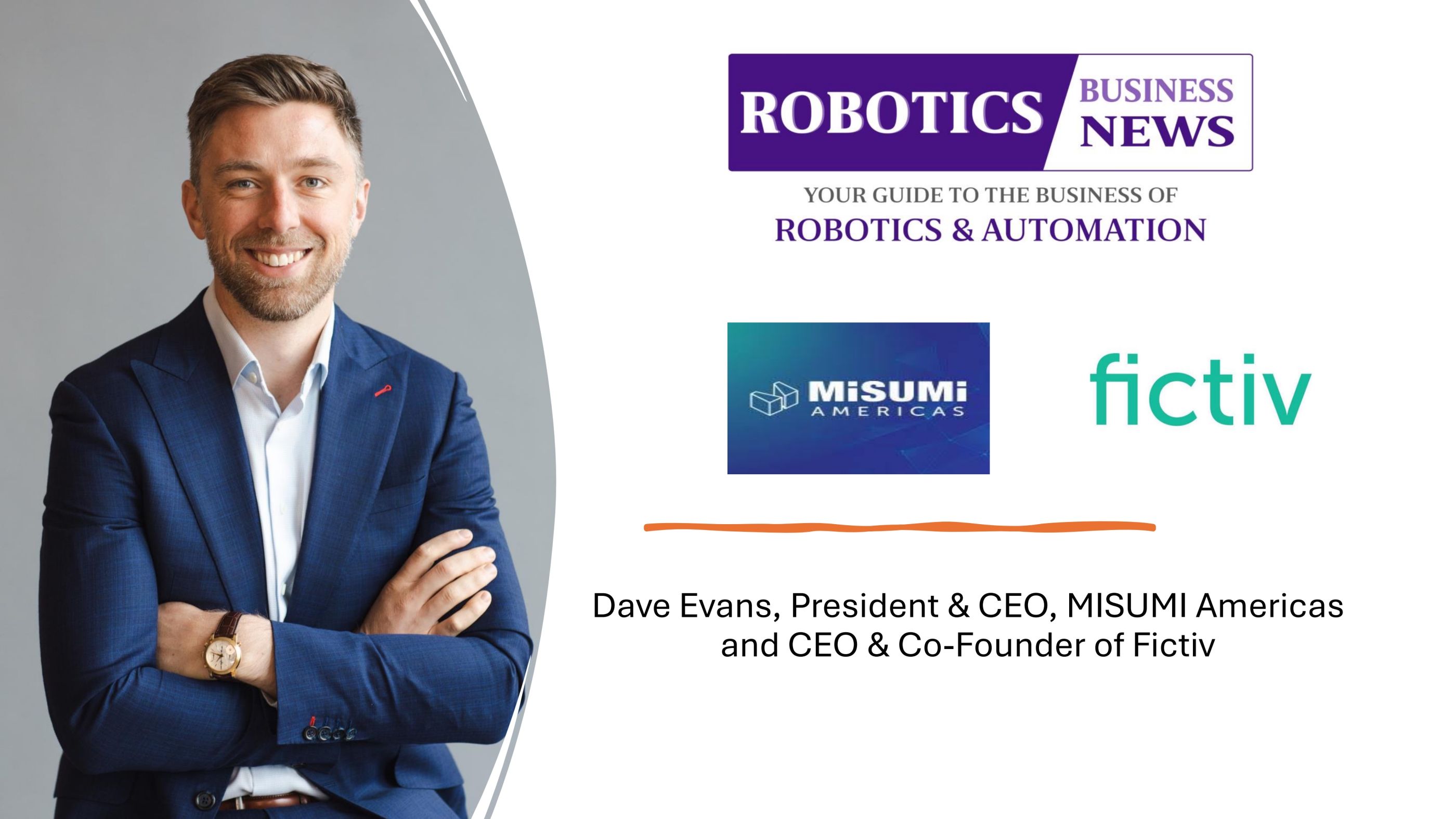
Robotics Business News spoke with Dave Evans, President & CEO of MISUMI Americas and CEO & Co-Founder of Fictiv, about MISUMI Ventures, the company’s new $50 million investment fund targeting frontier hardware, robotics, automation, industrial AI and advanced manufacturing technologies.
Evans explains how MISUMI plans to combine venture capital with engineering expertise, manufacturing capabilities and global supply-chain infrastructure to help startups overcome one of the industry's biggest challenges: moving from successful prototypes to reliable, scalable volume production.
What was the key strategic motivation behind launching the $50 million MISUMI Ventures fund, and how does it fit into MISUMI Americas' broader expansion in North America?
What we are trying to do here is pretty simple. We want to help invest in the best companies driving the most innovation, and to be a strategic partner to support that innovation.
How it fits into MISUMI Americas’ broader expansion: MISUMI Ventures is part of MISUMI Group's $1 billion Global Investment Vision, which the company announced earlier this year to fund growth. A significant share of that capital will be directed to the United States. North America is where a huge amount of industrial innovation is happening right now, and we wanted a permanent, institutional presence in that ecosystem rather than just showing up as a vendor after a company already has a product.
The strategic motivation is twofold. First, we want to be close to the companies that are going to define what factories look like in ten years — much like MISUMI has spent over 60 years building precision into the factories of today. Second, by backing these companies early, they get a manufacturing partner from their very first prototype instead of scrambling to find one once they hit a wall in production.
MISUMI Ventures is targeting frontier hardware, robotics, automation, and industrial AI. What specific technologies or startup opportunities are you most interested in supporting over the next three to five years?
Our focus is weighted toward two core areas, with a smaller allocation around the edges. The first is frontier hardware and automation — robotics, factory automation, and advanced manufacturing systems. The second is frontier AI and industrial software — things like supply chain intelligence, autonomous manufacturing, and generative design. Beyond that, we'll selectively look at adjacent categories like aerospace, eVTOL, satellites, climate technology, and medical devices when the opportunity is strong.
Over the next three to five years, I expect the most interesting opportunities to sit at the intersection of physical hardware and AI — companies that aren't just building a robot or a machine, but building the software layer that makes that hardware genuinely autonomous and production-ready at scale.
You have highlighted the difficulty hardware startups face when moving from prototype to volume production. What are the biggest manufacturing and supply-chain barriers you see today, and how will MISUMI Ventures address them?
Hardware companies rarely fail because the idea was wrong. They fail in the gap between a working prototype and repeatable, high-quality volume production. That gap is a supply chain problem — inconsistent vendors, slow quoting cycles, quality control that doesn't scale, and teams that have to rebuild their manufacturing relationships every time they change vendors.
That's precisely the problem MISUMI Ventures is designed around solving. When we invest, a founder gets access to an engineering and supply chain team that can quote in minutes, deliver parts in a day, and scale to thousands of units without switching vendors. That continuity — from first prototype through volume production, under one quality system — is what we think is the most valuable thing we can put on a cap table.
How will MISUMI's manufacturing capabilities and global supply-chain network differentiate MISUMI Ventures from traditional venture capital investors?
Most venture capital is just capital. What we bring alongside the fund is direct access to MISUMI Americas' full manufacturing support: more than 30 million standard parts, 22 company-owned factories, 42 million custom parts delivered to date, 40 million standard product variations, roughly 4,000 sourcing partners, and a five-region global network spanning the U.S., China, India, Japan, and Mexico.
That means a portfolio company gets full mechanical BOM support through one integrated digital workflow, automated design-for-manufacturing feedback, and manufacturing that's already certified to ISO 9001:2015, AS9100, and ISO 13485. It also means built-in supply chain resilience, since production isn't tied to a single region or a single vendor relationship. A traditional VC firm can help a founder raise their next round. We can help them actually build the product at scale.
Physical AI is creating new requirements for robotics and industrial systems. How do you expect the relationship between AI, robotics, and advanced manufacturing to evolve, and where does MISUMI see its role?
Physical AI is pushing intelligence out of the data center and into machines that have to move, sense, and act reliably in the real world — which raises the bar on the hardware itself. That means tighter tolerances, faster iteration cycles, and manufacturing partners who can keep pace with software teams that are used to shipping updates weekly, not yearly.
We see MISUMI's role as the connective tissue between that AI-driven pace of innovation and the physical discipline of manufacturing at scale. As robotics and industrial AI companies mature, the winners will be the ones who can close the loop between design, AI, and production fastest — and that's exactly where our supply chain network is built to help.
For a startup receiving investment from MISUMI Ventures, what does the partnership look like beyond the financial investment—from engineering and design-for-manufacturing support to scaling production?
It starts with capital — typically $500,000 to $2 million at the initial investment, and we can go much higher for the right investments — but that's really just the entry point. From there, portfolio companies get access to our engineering and supply chain team for design-for-manufacturing feedback, quoting turnaround measured in minutes rather than weeks, and a manufacturing continuum that can take them from a handful of prototype units to thousands of production units without having to re-qualify a new vendor.
Because that manufacturing relationship runs through a single quality management system across our global network, founders also get supply chain resilience built in from the start — they're not locked into one factory or one region as they scale. And because we're a patient investor with a decade-long fund horizon and deep operating experience in industrial manufacturing, we're positioned to stay engaged well past the first check.
Looking ahead to the fund's first investments and planned portfolio, what would success look like for MISUMI Ventures, and how do you expect the fund to influence the next generation of industrial and robotic companies?
Success looks like a portfolio of 20 to 30 companies where our manufacturing support genuinely changed their trajectory — where a founder can point to us and say the transition from prototype to volume production didn't slow them down, or didn't kill them, because they had a manufacturing partner in the room from the beginning. We will not lead rounds. We will follow-on with some of the best investors.
We expect to make our first investment by the end of this year, and we're building toward that portfolio methodically rather than rushing capital out the door.
More broadly, I'd like MISUMI Ventures to become known as the fund that took the hardware-to-production gap seriously as an investment thesis, not just a talking point. If we do this well, we help define a model where manufacturing capability is treated as a core part of a robotics or industrial AI company's competitive advantage — not something bolted on after the technology is proven.