Ethernovia’s Ramin Shirani and Chris Mash on Building the “Nervous System” for Physical AI and Autonomous Machines
16 February 2026 | Interaction | By Editor Robotics Business NEWS <editor@rbnpress.com>
In an exclusive Robotics Business News interview, Ethernovia’s leadership explains how deterministic Ethernet networking is redefining autonomy, enabling safer humanoid robots, software-defined vehicles, and real-time AI systems to operate reliably at scale.
As autonomous vehicles, humanoid robots, and intelligent machines move from experimentation to real-world deployment, networking infrastructure is emerging as a critical bottleneck for physical AI. In this exclusive interview with Robotics Business News, Ethernovia CEO and Co-Founder Ramin Shirani and VP of Business Development Chris Mash explain why reliable, deterministic data delivery—not just better algorithms—is the key to safe autonomy. The executives share how Ethernovia’s Ethernet-native platform is transforming machine connectivity into a programmable, time-synchronized “nervous system” designed to support next-generation robotics, software-defined vehicles, and industrial automation at scale.
What problem in autonomous and AI-driven systems led Ethernovia to develop its networking and compute platform?
Ramin Shirani, CEO & Co-Founder: “Autonomous vehicles and humanoid robots fail not because of insufficient algorithms but because data arrives late, inconsistently, or unreliably. Control, perception and decision-making are only as good as the timing and integrity of their inputs.”
Three fundamental constraints have dominated early autonomy programs and continue to limit mainstream deployment of intelligent machines:
Bandwidth starvation: Next generation sensors create a huge amount of data about the real world that need to be aggregated and routed around the machine to the brain or CPU. Before the advent of MultiGig Ethernet, the lack of bandwidth limited what high bandwidth data could be routed.
Latency and jitter: Safety-critical control loops, sensor fusion, and actuation require bounded, deterministic timing—something hard to guarantee under load or fault conditions. In a humanoid robot operating alongside humans, or an autonomous vehicle traveling at highway speeds, unpredictable delays can mean the difference between safe operation and catastrophic failure.
Rigid architectures: Legacy systems lock functionality to hardware through dozens of ECUs and proprietary links, making hardware and software updates, feature expansion, and system-level safety certification slow and prohibitively costly.
Incremental fixes such as more bandwidth or faster processors don't solve this fundamental problem. Without deterministic delivery and isolation, increasing complexity actually increases risk, causing safety margins to shrink as systems scale.
Ethernovia's answer is a unified, Ethernet-native data plane with deterministic quality of service (QoS) and tight time synchronization that treats data as an end-to-end resource—from sensor to switch to compute to actuator. This establishes the stable foundation that provides predictable latency, synchronized time, fault containment, and observability that physical AI systems require to reason reliably about the world and act safely within it.
How does Ethernovia's packet-based architecture differ from traditional networking solutions used in vehicles and industrial systems?
Chris Mash, VP of Business Development: “Traditional Ethernet switches used in today's automotive networks are derived from small switches originally designed to power home gateways and routers, with features such as Time-Sensitive Networking (TSN) and TCAMs (basic packet inspection) bolted on afterward. While this worked for early generations of vehicles where the in-vehicle network wasn't carrying mission-critical data, the advances in ADAS/AD toward Level 4 autonomy and the move toward physical AI intelligent machines operating alongside humans demands that safety becomes absolutely critical.
Our packet processor architecture has been designed from the ground up to meet the most stringent requirements for functional safety, with the flexibility inherent in a packet processor design to support automotive, robotics, and intelligent machines across industrial automation.”
Ethernovia's approach differs in four fundamental ways:
Ethernet-first, not Ethernet-added: A homogeneous Ethernet backbone carries everything—control, diagnostics, bulk sensor data—rather than stitching Ethernet onto legacy buses. This unified fabric eliminates the complexity and failure points of hybrid architectures.
Deterministic by design: Through hardware-accelerated TSN scheduling, shaping, and policing, we guarantee worst-case latency and jitter for safety-critical traffic even at peak load, without the silicon overhead or management complexity of traditional Ethernet solutions. Our packet processor architecture embeds programmability directly into the pipeline, providing class-leading packet forwarding latency with guaranteed, deterministic, and time-bound delivery of data.
Hardware-defined networking: Logical separation and secure partitioning replace hardwired domains, enabling feature mobility, over-the-air evolution, and graceful fault containment while maintaining continuous operation. The network becomes a governed, observable, deterministic substrate—not passive infrastructure.
Zonal + centralized compute-ready: High-bandwidth aggregation at the edge combines with low-latency links to centralized AI compute, mirroring modern data center fabrics but hardened for robots, factories, and vehicles.
Additionally, all of our products use a 7nm process—the most advanced currently available for automotive and mobility network silicon. This gives us the industry's lowest power consumption for our PHYs and packet processors, which is critical for battery-powered humanoid robots where operation is measured in minutes rather than hours, and essential for electric vehicles.
The net effect is an AI-era fabric that scales with sensor count and model complexity while preserving safety and serviceability.
What role does "physical AI" play in the future of autonomy, and how does your technology enable it?
Ramin Shirani, CEO & Co-Founder: “Physical AI is intelligence that perceives, decides, and acts in the real world—machines and systems that can observe their surroundings, understand context, reason about what they're seeing, and take action in physical environments. This is fundamentally different from cloud-based AI, which operates in controlled digital environments without real-time physical consequences.
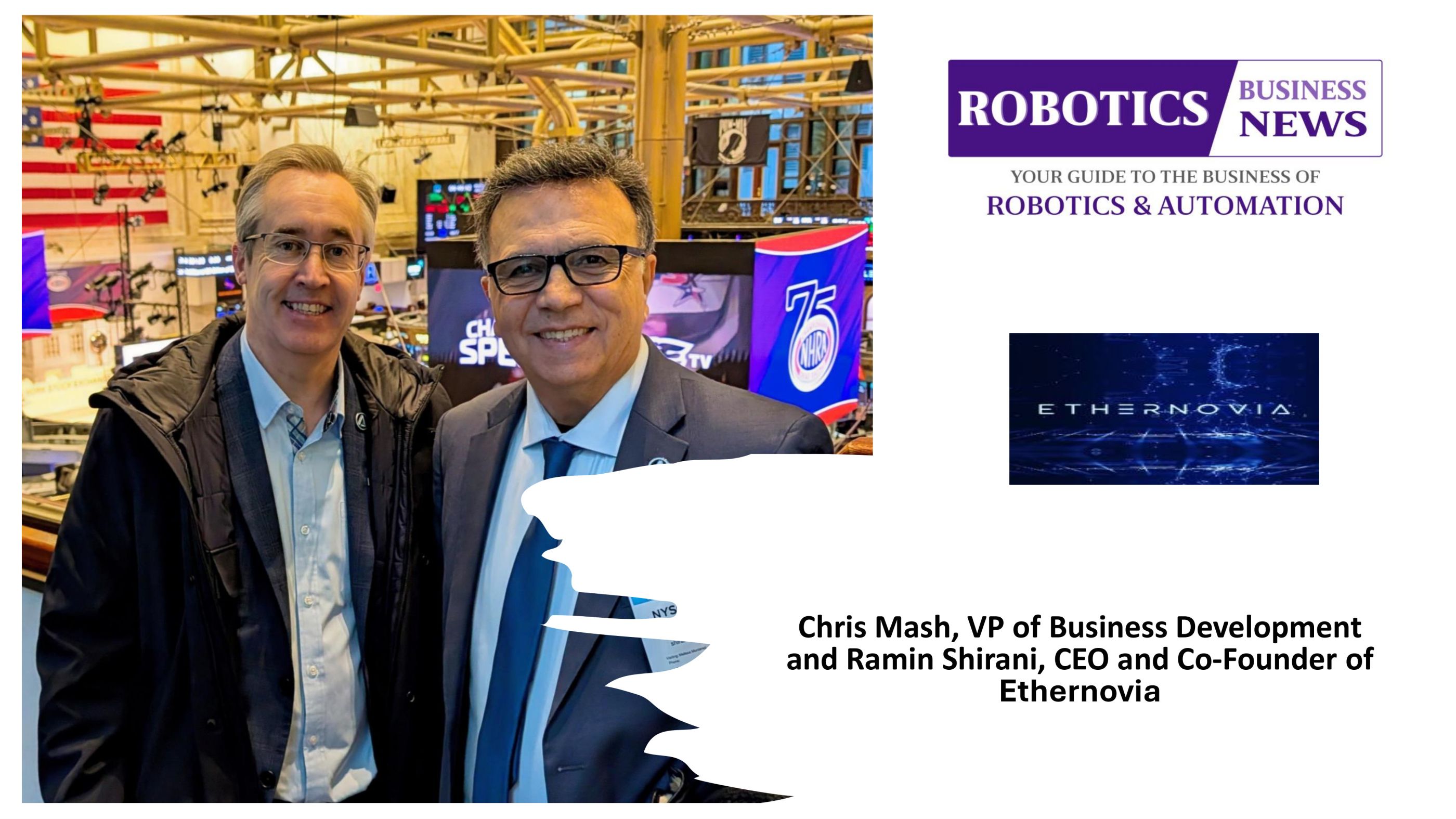
As described in Ethernovia’s recent NYSE interview, Ramin had this to add: "We like to think of Ethernovia as being the nervous system of intelligent machines—in robots, autonomous vehicles, and edge devices." Just as the human nervous system coordinates sensing, processing, and action with precise timing, physical AI systems require a network infrastructure that can do the same.”
The nervous system of these intelligent machines must handle three critical functions:
Perception with fidelity: Multi-gigabit links carry rich sensor data to keep AI models signal-rich. Cameras, radars, lidars, and other sensors generate enormous data streams that must arrive intact and on time.
Real-time actuation: Deterministic scheduling ensures control paths remain bounded even as background traffic surges. Whether it's a humanoid robot grasping an object or an industrial robot working on an assembly line, the time between sensing and acting must be predictable and guaranteed.
Workload convergence: Partitioned, virtualized infrastructure co-hosts perception, planning, telematics, and diagnostics with safety isolation. This allows intelligent machines to run multiple AI workloads simultaneously without compromising safety-critical functions.
Connectivity is the foundation for next-generation autonomous vehicles and robots. There's significant emphasis on AI processors and sensors, but what truly enables physical AI to scale is the nervous system of the machine—how you take data from sensors all the way to the CPU and GPU, analyze it, and then take action. That connectivity within robots, autonomous vehicles, and intelligent machines is the foundation of the AI pipeline.
By extending the same architectural principles from software-defined vehicles to robotics and industrial automation, Ethernovia makes physical AI deployable at fleet scale, moving beyond pilot trials to real-world production environments.
How will the $90+ million Series B funding accelerate product development and commercialization?
The Series B funding accelerates our mission across three key areas:
Product development: We're accelerating development of physical AI-enabled next-generation Ethernet packet processors, PHYs, and compute devices optimized for automotive architectures and humanoid robotics platforms, enabling parallel development across multiple product lines.
Team expansion: As our CEO noted in the NYSE interview, "The company is primarily built with key engineers, and really the biggest asset of the company is our engineering talent. So, we're going to continue hiring the best engineers and the best of the breed in the world."
Market timing: We're at a critical inflection point in the evolution from cloud AI to physical AI, with tremendous momentum toward robots and autonomous vehicles. This funding is fundamental for executing our roadmap as the industry converges on the architectural approach we've pioneered.
Our strategic investors—Qualcomm Ventures, AMD Ventures, and Porsche SE—recognized that Ethernovia is redefining the role of the network in physical AI systems, providing a deterministic, programmable fabric that scales across vehicles, robots, and machines while reducing system-level risk.
What makes Ethernovia's approach particularly suited for software-defined vehicles and intelligent machines?
Software-defined vehicles (SDV) and intelligent machines depend on continuous software evolution—the ability to update features, add capabilities, and improve performance throughout the product lifecycle. This fundamental requirement drives several architectural imperatives that Ethernovia's approach uniquely addresses.
Decoupled zones and logical partitioning: Network virtualization and logical partitioning enable features to move across compute zones with high integrity. This means that as software evolves, functionality can be redistributed across the system without requiring hardware redesigns or physical rewiring.
End-to-end quality of service: Our architecture supports data aggregation at the edges with guaranteed QoS despite crossing one or more switches. Whether intelligence is centralized or distributed, the entire system operates as one deterministic fabric, ensuring predictable behavior regardless of where processing occurs.
Safety and resiliency as system properties: We integrate the maintainability, software updating, and safety requirements of automotive systems as core properties in physical AI-enabled robotics. Deterministic transport, fault-tolerant network topologies, and fail-operational behaviors are built into the fabric from the ground up—not bolted on as afterthoughts.
Observability and programmability: The network actively enforces policy, exposes timing and health metrics, and prevents non-critical AI workloads from degrading control and safety paths. This transforms the network from passive infrastructure into a governed system component that OEMs can reason about holistically.
As physical AI systems gain autonomy and accountability, this shift from treating the network as "plumbing" to treating it as a programmable, observable system component isn't optional—it's the difference between scaling complexity safely or not scaling at all.
How do you see demand evolving across automotive, robotics, and industrial automation markets?
All three segments are converging on common architectural requirements: Ethernet-native, deterministic, software-virtualized systems driven by AI workloads. This convergence is accelerating adoption across all markets simultaneously.
Automotive: Proving ground and scale
Automotive systems rapidly evolved to zonal SDV platforms as sensor counts and autonomy features expanded, making Ethernet a strategic choice. The automotive industry's experience with functional safety standards (ASIL ratings), over-the-air updates, and fleet-scale deployment provides valuable lessons and validation for robotics applications. Automotive serves as both a demanding proving ground and a pathway to volume production
Robotics: The fast adopters
Humanoid and general robotics are rapidly adopting these core architectural principles. Physical AI in robotics demands human interaction capabilities, predictive awareness, and real-time responsiveness—all enabled by deterministic networking. We see robots as fast adopters because they inherently require the tight sensor-to-actuator control loops and safety guarantees that our architecture provides.
Industrial automation and human assistance
While humanoid robotics captures headlines, we must not lose sight of the massive opportunity in traditional manufacturing environments. Industrial automation, warehousing, and inspection systems are evolving to support human co-workers on production lines. These applications require the same deterministic, safe networking that enables collaborative robots to work alongside people without safety cages or restricted zones.
The key insight is that these markets aren't separate—they're parallel deployments of the same fundamental architecture, each adapted to specific form factors and operational requirements. A packet processor designed for a vehicle's zonal architecture can be configured for a humanoid robot's torso or an industrial robot's control cabinet. This architectural convergence creates a flywheel effect where improvements in one market benefit all others.
What technical challenges must be solved to scale high-performance networking for real-time AI systems?
Scaling physical AI systems requires solving several interrelated technical challenges that go beyond simply providing more bandwidth:
Determinism under stress: The network must guarantee worst-case performance despite congestion, failovers, and mixed-criticality traffic. This means maintaining timing guarantees even when safety-critical control loops, AI perception workloads, and diagnostic traffic all contend for bandwidth simultaneously. Traditional "best-effort" networking fails catastrophically in these conditions.
Time synchronization across distributed systems: Multi-sensor fusion and coordinated actuation through real-time control loops require precise time synchronization. When a humanoid robot uses vision, force sensors, and joint encoders to manipulate an object, all sensor data must be timestamped and fused with sub-microsecond accuracy.
Heterogeneous QoS across the entire network: Different traffic types—control, safety, sensor data—require different handling with hardware-accelerated encapsulation, policing, and shaping. The network must enforce these policies automatically and reliably across every hop from sensor to compute to actuator.
Co-designed safety and security: Advanced functional safety ratings up to ASIL-D must be designed in from the start, not added later. This includes technologies like our ForeSight Diagnostics™, which provides continuous feedback and predictive maintenance capabilities. For example, in articulated robot joints where cables pass through multiple moving parts, the system must detect signal degradation over time—not just catastrophic link failures—and predict problems before they impact operation.
Power efficiency at scale: For battery-powered systems like humanoid robots and electric vehicles, every watt matters. Network silicon must provide deterministic performance while minimizing power consumption—a challenge that requires architectural innovation and optimized process technology such as our industry first and technology leading 7nm process.
Programmability without latency penalties: The flexibility to adapt to new AI workloads and safety requirements must not compromise deterministic timing. This requires packet processor architectures that embed programmability directly in the hardware pipeline rather than relying on software that adds latency, power, and non-deterministic behavior.
These challenges are interconnected—solving one without addressing the others creates bottlenecks elsewhere in the system. This is why Ethernovia takes a holistic approach, treating the network as an integrated system component rather than passive infrastructure.
Looking ahead, what milestones should the industry watch for as Ethernovia moves toward broader deployment?
Several key milestones will mark Ethernovia's transition from early adoption to mainstream deployment across physical AI platforms:
Next-generation SDV and physical AI platform adoption: You'll see Ethernovia being adopted in next-generation software-defined vehicles and physical AI platforms, marking the inflection from pilots to scale. This represents the validation that our architectural approach meets the stringent requirements of production systems.
Field team expansion and global support: Supported by our Series B funding, we're expanding our field teams globally. This customer-facing expansion enables us to support the worldwide customer base required for mainstream adoption and ensures that companies deploying physical AI systems have the technical expertise they need for successful integration.
Industry standards and ecosystem development: As more companies adopt Ethernet-native architectures for physical AI, we expect to see industry standards coalesce around deterministic networking, safety-critical packet processing, and software-defined infrastructure. Ethernovia's early leadership positions us to help shape these standards.
Cross-market deployment validation: Watching for Ethernovia technology deployed across automotive, robotics, and industrial automation simultaneously will demonstrate the universal applicability of our architecture. This cross-pollination accelerates innovation as learnings from one market inform improvements across all others.
The broader narrative to watch is the industry's recognition that the network is not infrastructure but the nervous system—that connectivity is as critical as compute for enabling physical AI to scale safely and reliably in the real world. As that understanding takes hold, architectural approaches that treat networking as an afterthought will give way to Ethernovia's vision of the network as a first-class system component.
About Ethernovia: Ethernovia develops Ethernet-native network architectures purpose-built for physical AI systems. The company's packet processor technology provides the deterministic, programmable networking infrastructure that enables autonomous vehicles, humanoid robots, and intelligent machines to perceive, decide, and act safely in the real world.