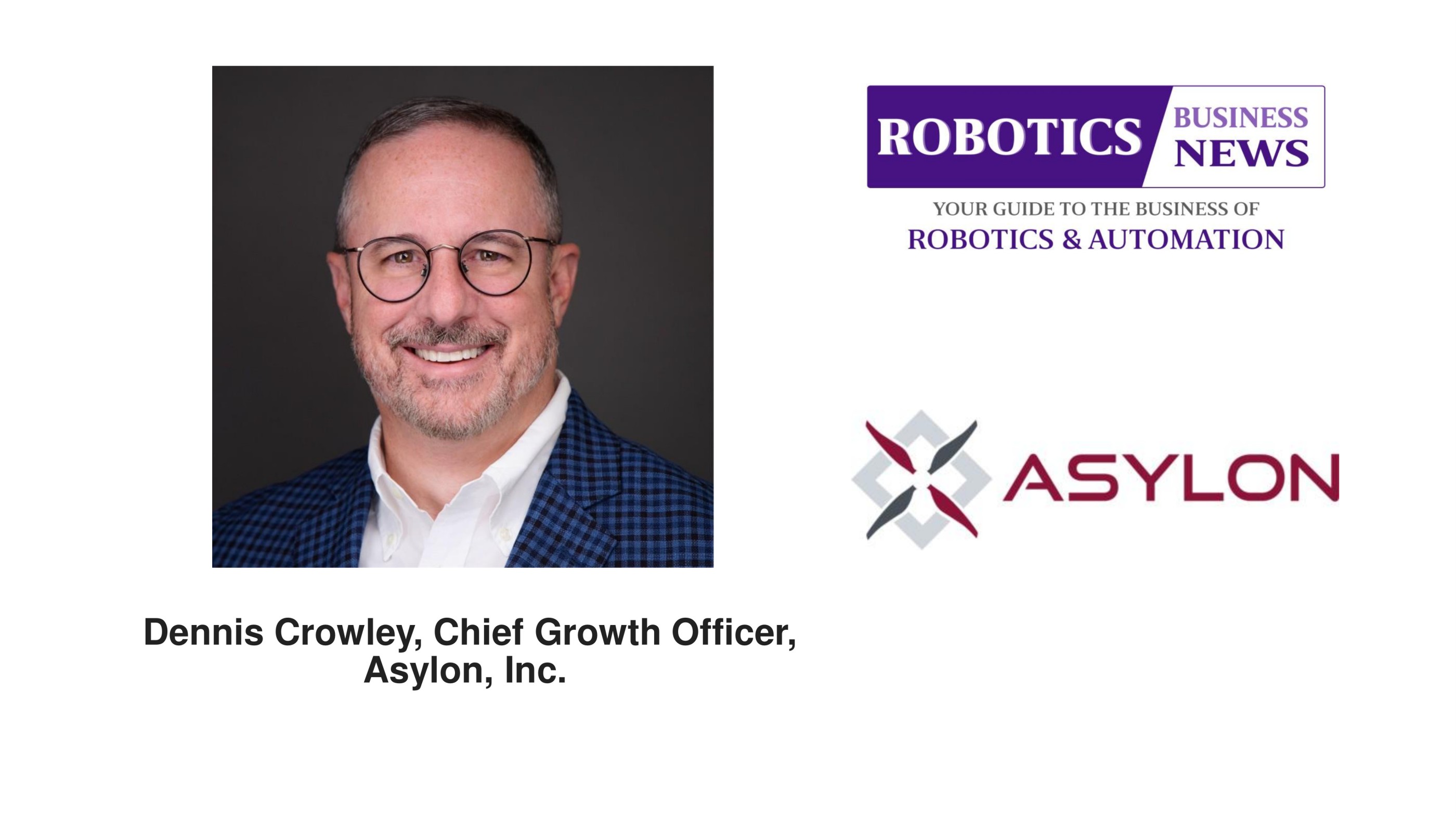
Operationalizing Physical AI — Asylon’s Dennis Crowley on Scaling Intelligent Perimeter Security
10 April 2026 | Interaction | By Editor Robotics Business NEWS <editor@rbnpress.com>
In an exclusive conversation, Dennis Crowley shares how Asylon Inc is combining robotics, AI, and workflow automation to transform enterprise security from reactive monitoring to intelligent, outcome-driven operations.
As enterprise security faces growing complexity, labor shortages, and rising expectations for accountability, a new model is emerging—one powered by Physical AI. In this exclusive conversation with Robotics Business News, Dennis Crowley, Chief Growth Officer at Asylon, discusses how the integration of autonomous robotic patrols, AI-driven analytics, and unified workflow platforms like Thrive Logic is enabling organizations to move beyond reactive monitoring toward proactive, consistent, and scalable security operations. Drawing on real-world deployments and measurable outcomes, Crowley outlines how this approach is reshaping perimeter security across industries.
Strategic Vision & Industry Direction
What does the integration with Thrive Logic represent for your long-term vision of Physical AI in perimeter security?
For the last decade, enterprise security has been asked to do more with less—more perimeter, more assets, more compliance expectations—while facing the same operational constraints: labor volatility, inconsistent coverage, and fragmented systems. Our long-term view of Physical AI is a direct response to that reality. It's the practical convergence of three things security leaders need today: persistent presence (robots), decision intelligence (AI), and accountable execution (guided workflows with humans in the loop).
The Thrive Logic integration represents a meaningful step forward in that vision because it connects patrol volume to operational outcomes. Asylon has built a model around structurally high patrol density in exterior perimeter environments. Our robotic systems—ground and aerial—create that persistent presence, and our 24/7 Robotic Security Operations Center (RSOC) ensures it's monitored, managed, documented, and accountable.
But persistent presence alone isn't enough if the output stays trapped in individual dashboards or becomes "more video to watch." Thrive Logic unifies video, access control, sensors, and alarms into a single environment for the SOC analyst, then applies AI-driven analytics and workflow automation so that when a defined condition is met, the operator doesn't have to improvise. When we connect Asylon's robotic patrol streams into Thrive Logic, we're embedding mobile perimeter presence into an enterprise-grade decision and workflow layer.
In the long run, the winning enterprise programs will treat perimeter security the way operations treats uptime: standardized execution, tight workflows, and defensible reporting. Physical AI is how security gets there.
How do you see Physical AI transforming enterprise security operations from reactive monitoring to proactive decision-making?
Traditional security operations are built around a reactive model: an alarm triggers, a camera is checked, a call is made, an incident gets logged—often inconsistently, often dependent on who was on shift. That model produces two chronic issues: response friction (too many steps, too much noise) and inconsistent execution (varying patrols, varying documentation, varying follow-through).
Physical AI shifts that model by changing what the system is designed to do reliably:
- Create persistent, structured coverage of exterior perimeters through autonomous patrols
- Filter and prioritize what matters using AI to identify defined conditions and anomalies
- Drive consistent action via guided workflows aligned to SOPs, with human verification and accountability
In patrol-dense environments—large logistics yards, industrial campuses, utility sites—proactive operations are particularly important because the exposure surface is large and consequences are high. The question is not "Can we see it on camera?" The question is "Do we reliably patrol it, detect issues early, respond consistently, and prove we did?"
With Thrive Logic, the SOC analyst isn't just watching a feed. They're working inside a unified environment where robotic video can be analyzed alongside fixed cameras, access control, and intrusion alarms—then translated into guided action aligned to SOP. Proactive security isn't just detecting earlier. It's deciding and executing faster, with fewer gaps and a clear evidence record.
Technology & Innovation
Can you explain how the combination of autonomous robotic patrols and AI-driven analytics creates a more effective security solution compared to traditional systems?
Traditional systems—cameras, alarms, access control—are largely static, and static infrastructure has inherent limitations in exterior perimeter environments. Cameras have blind spots. Lighting varies. Perimeters shift. Autonomous robotic patrols add a mobile layer that changes the equation: consistent patrol volume across the perimeter, day after day, shift after shift, without the variability that comes from staffing constraints or competing demands.
The real advantage emerges when you connect that mobile presence to an AI-driven analytics and workflow layer:
- Robots increase signal availability. More observations, more angles, more coverage—especially in large exterior spaces.
- AI-driven analytics increase signal quality. Instead of forcing analysts to manually interpret every feed, analytics surface defined conditions so humans focus on what matters.
- Workflows turn signals into outcomes. Who gets notified, what steps are followed, what evidence is captured—executed consistently.
When Asylon streams robotic video into Thrive Logic, the robotic patrol layer becomes a first-class input into the same analytic and workflow fabric as fixed infrastructure. It also directly addresses fragmented tooling—cameras in one system, alarms in another, SOP binders outside the workflow entirely. For a CSO, "effectiveness" is measured by reliability, speed, and defensibility. This combination delivers on all three.
What role does AI-driven workflow automation play in improving response time and operational efficiency for security teams?
Workflow automation is where security either becomes scalable—or stays stuck in a labor-intensive model that breaks under pressure. In many SOC environments, response time isn't limited by detection alone; it's limited by everything that happens after: finding the right camera, validating the event, deciding how to escalate, documenting what happened. Each step creates friction, and friction creates delay.
AI-driven workflow automation reduces that friction in two ways: standardizing the path from event to action, and reducing the manual overhead required to execute that path consistently. When a defined condition is met in Thrive Logic, the platform surfaces the event, contextualizes it across system inputs, and triggers an incident workflow aligned to SOP—so the analyst doesn't reinvent the process; they're guided through it.
In patrol-dense environments, this matters even more because observation volume is higher. You don't want to create a workload explosion in the SOC. You want better security outcomes per analyst hour. Automated workflows also produce the time-stamped records and consistent reporting that security leaders increasingly need for compliance, insurance, and post-incident review. In short: automation helps response time by reducing decision lag, and improves operational efficiency by standardizing execution without simply adding headcount.
Operational Impact & Value
How does this integration help organizations address key challenges such as labor shortages, inconsistent patrols, and increasing security demands?
Labor shortages and turnover are structural. Guarding costs continue to rise. Perimeters are expanding. Expectations for measurable performance are increasing from internal stakeholders, regulators, and insurers. This integration helps by combining two stabilizing forces: consistent patrol execution and structured decision workflows.
Autonomous robotic patrols directly address inconsistent coverage. In many exterior environments, patrol consistency breaks first when staffing is tight—rounds get reduced, documentation becomes sporadic. Robots don't eliminate the need for humans; they change how humans are used. They take on repeatable perimeter presence while operators focus on verification, escalation, and judgment. Thrive Logic's unified platform and workflow automation then reduce the cognitive and administrative load on the SOC, helping teams manage more complexity without linear headcount growth.
Together, the model supports defensible operations: robots create reliable patrol volume, analytics reduce noise, workflows guide consistent response, and reporting becomes systematic. From a labor standpoint, organizations reduce their dependence on perfect staffing to achieve baseline perimeter coverage—and as security demands increase, the model scales through standardization rather than pure headcount.
What measurable outcomes can customers expect from this solution?
Customers can expect measurable improvements across several categories:
- Patrol frequency and coverage consistency. Higher patrol volume and fewer coverage gaps in exterior perimeters. Key KPIs: patrols per week, route completion rate, missed patrol reduction.
- Faster verification and reduced response friction. Less time spent hunting for context and deciding what to do next. Key KPIs: time-to-verify, time-to-escalate, incident resolution cycle time.
- Improved response consistency. The same incident handled by different shifts produces consistent outcomes. Key KPIs: SOP adherence rate, escalation completion rate.
- Audit-ready reporting. Time-stamped incident records and evidence packages that stand up to internal and external review. Key KPIs: incident record completeness, audit preparation time reduction.
- Guarding efficiency improvements. Better cost-to-coverage ratio through reduced overtime, labor redeployment, or replacement of low-value routine patrol.
Asylon's operational track record anchors these outcomes in real-world performance: 335,000+ robotic security missions, 250,000+ miles patrolled, and 11,000+ hours flown. That's evidence this is operational infrastructure, not experimentation.
Growth & Future Outlook
Which industries or use cases are you prioritizing for deployment of this integrated Physical AI solution?
We prioritize industries where three conditions are true: the environment is perimeter-intensive and exterior-focused; the required patrol density is structurally high; and the organization has measurable friction in the current guarding model—economic, operational, or risk-driven—and leadership wants scalable, defensible improvement.
Our primary focus areas:
- Logistics / Yard Operations. Large yards, distribution centers, and intermodal facilities with high asset density and real costs from inconsistency—cargo theft, unauthorized access, compliance exposure. Robotic patrol streams combined with fixed camera networks in Thrive Logic enable faster triage and guided response, with potential for asset awareness workflows like trailer identification.
- Utilities and Power Generation. Clear perimeter requirements, high consequences, and strong drivers for defensible reporting make utilities a strong fit. Consistent patrol and audit-ready documentation are part of operational risk management here.
- Critical Infrastructure — Water. Water and wastewater facilities face increasing security pressure with limited staffing elasticity. Remote assets and compliance expectations create the exact scenario where persistent patrol plus guided incident response can materially improve program maturity.
- Industrial / Manufacturing Campuses. Complex perimeters, mixed asset types, and varying risk zones. Robotics provides consistent patrol while the unified analytics and workflow layer helps SOC teams manage complexity without creating a monitoring burden.
We are selective about where we deploy because our focus is win rate and enterprise expansion in environments where the operational need is real and repeatable.
Looking ahead, how will Asylon continue to evolve its platform to further integrate AI, robotics, and real-time decision intelligence?
Our roadmap is centered on turning robotic perimeter security into a higher-maturity operating model: more consistent patrol execution, more intelligent prioritization, and more defensible outcomes at enterprise scale. Three evolution tracks matter most:
- Deeper operational integration. Robotic patrol streams should plug into the same operating environment where security teams make decisions—alongside fixed cameras, access control, and operational signals. We'll continue expanding integrations that make robotic outputs more actionable inside the tools enterprise teams already use, while keeping human accountability at the center.
- Smarter decision intelligence with human verification. The future is security professionals augmented by AI that reduces noise, surfaces anomalies, and improves consistency—not AI that replaces judgment. We will continue to build and partner around analytics that elevate situational awareness while ensuring outcomes remain defensible. A CSO needs to explain not just what the system detected, but how decisions were made and what controls exist.
- Enterprise scaling through standardization. The biggest value creation comes from applying the same patrol logic, analytic conditions, and workflows across sites. We will keep investing in the operational tooling, reporting frameworks, and deployment processes that allow customers to expand from one site to many without reinventing the program each time.
Our north star is straightforward: reduce guarding friction, improve consistency, and deliver defensible perimeter security outcomes that scale. The Thrive Logic integration moves us forward by turning robotic patrol visibility into structured action and documented results—exactly what enterprise security leaders need today.