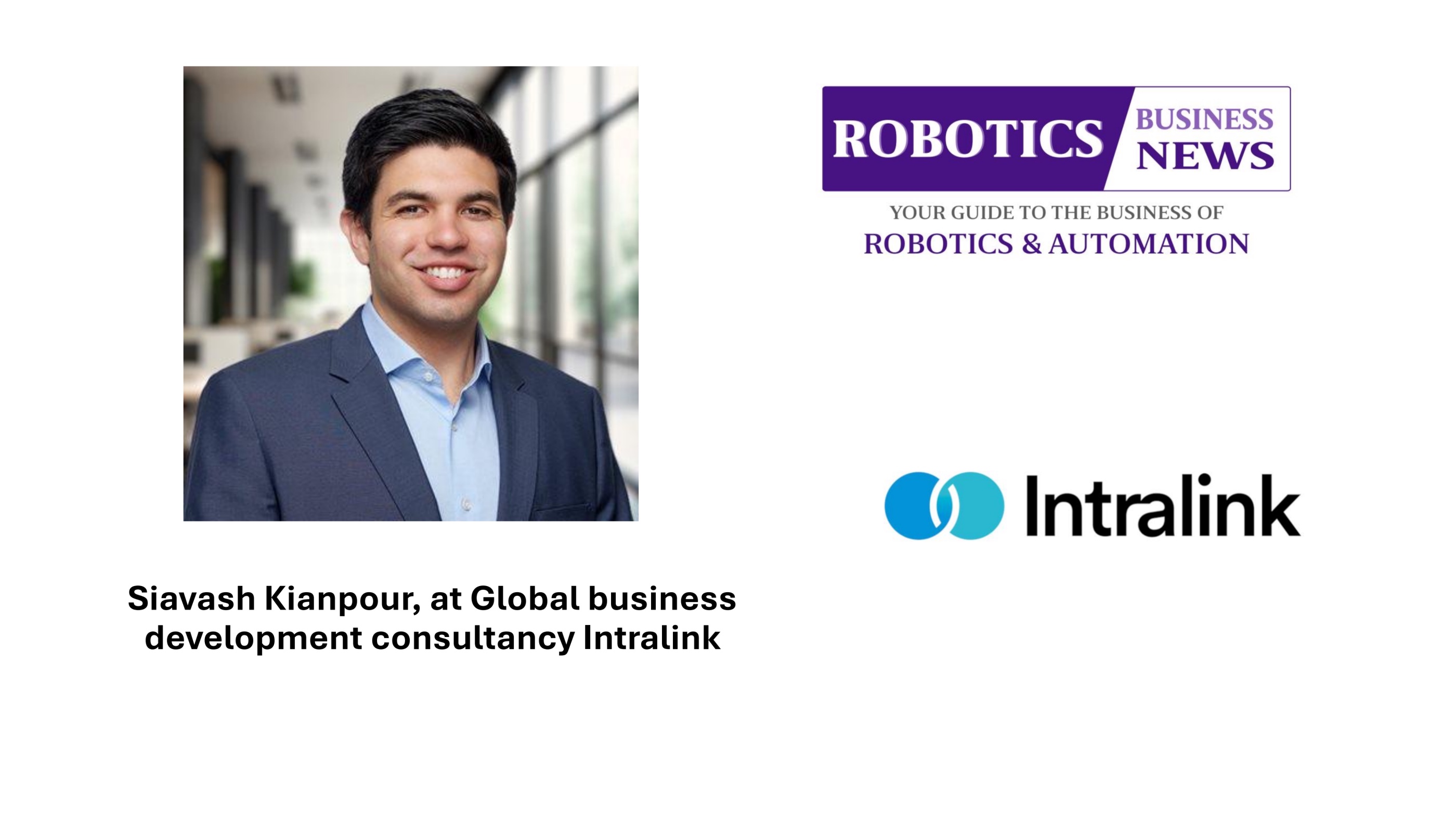
“South Korea’s Robotics Boom Creates Major Opportunities for Global Technology Companies” — Siavash Kianpour of Intralink
03 June 2026 | Interaction | By Editor Robotics Business NEWS <editor@rbnpress.com>
In an exclusive conversation with Robotics Business News, Siavash Kianpour, Director of Business Development for North America at Intralink, discusses South Korea’s rapidly growing robotics and UAV sectors, market-entry strategies, cross-border innovation, and the evolving role of Physical AI in Asia.
South Korea’s robotics and drone industries are expanding at an unprecedented pace, driven by government investment, advanced manufacturing capabilities, and growing demand for next-generation technologies. In this interview with Robotics Business News, Siavash Kianpour, Director of Business Development for North America at Intralink, shares insights into the country’s thriving innovation ecosystem, the importance of local partnerships, and how emerging trends in Physical AI, robotics, and battery technologies are creating new opportunities for global companies seeking growth in Asia.
What attracted Intralink to partner with Amprius on its South Korea expansion strategy?
We were happy to be appointed by Amprius Technologies to help them expand in South Korea because we were impressed by their innovative battery cell technology, for which we expect strong demand in key growth sectors in the country, such as the unmanned aerial vehicles (UAV) — drones — and robotics sectors.
In terms of UAVs, Korea is investing heavily in this technology as part of its expanding defense strategy. The country’s 2026 UAV defense budget is set to increase by 8.2% year-on-year as it seeks to strengthen its protection against potential threats from North Korean drones.
And the technology’s importance goes beyond Korea’s own defense strategy. With conflicts raging in many regions of the world and global defense spending increasing, Korean defense manufacturer LIG Defense & Aerospace, for example, is increasing its exports of UAV components and systems to the country’s allies. The huge growth in the UAV market in Korea makes it an attractive target for Amprius.
Looking beyond defense applications, Korea has also moved rapidly from pilot drone programs to the active commercialization of drone logistics and delivery services, supported by government deregulation and the rapid growth of the country’s on-demand delivery economy. This is another significant opportunity for Amprius’ ground-breaking battery technology.
In terms of the robotics sector, Korea has the world’s highest robot density, with 1,012 robots per 10,000 manufacturing workers — more than six times the global average. And there’s more to come. The government’s Fourth Intelligent Robot Basic Plan commits more than USD 2.24 billion in combined public and private investment by 2030 to robotics technologies, with the aim of deploying one million advanced robots nationwide. Again, growth on this scale is an excellent opportunity for Amprius.
South Korea has a sophisticated drone and robotics ecosystem. What makes the market unique for foreign technology companies trying to establish a foothold there?
Korea is one of the most sophisticated drone and robotics markets in Asia, driven by strong government support, advanced manufacturing capabilities, and a high degree of technology adoption across both the defense and commercial sectors.
The ecosystem includes major multinational OEMs such as Samsung, Hyundai Motor Company, Kia, Hanwha Aerospace, Doosan Robotics, LIG Nex1, and Korea Aerospace Industries. These companies are seeking international technologies and partnerships to enhance the performance of their products, accelerate development cycles, address technical capability gaps, and strengthen the global competitiveness of their exports.
Korean corporates work closely with a well-developed network of systems integrators, distributors, investors, and commercial partners, all of which can help international companies enter and scale within the Korean market.
And, it’s worth noting that, following that a slowdown in startup investment activity in Korea in 2023, the market is now recovering well, with investment returning to those sectors viewed as strategically important. These include AI, semiconductors, robotics, defense, and advanced manufacturing.
How does Intralink help international companies navigate cultural, commercial, and relationship-building challenges in the Korean business environment?
We are a business development consultancy specializing in international markets. We help companies secure overseas customers, partners and investors, guiding them through the cultural, regulatory and language barriers that can make entering new markets challenging. This is particularly true in South Korea and other high-opportunity Asian markets, which can feel complex and unfamiliar to international companies, especially those from the US and Europe.
Our support is delivered principally through our teams embedded in each country. Bilingual, technically literate, with well-established networks in key industry sectors, they understand how business is done on the ground — how to generate early momentum, and how to convert initial interest into sustainable short- and long-term commercial opportunities.
In Korea, where relationships, trust, technical validation and local partnerships are critical, our teams accelerate the building of relationships, representing their clients in the market until a robust commercial pipeline has been established.
Take Ceres as an example. This UK company developed a breakthrough solid oxide fuel cell (SOFC) technology. We supported their expansion in Korea over more than six years, guiding them from early market engagement through to a £36 million (USD48 million) partnership with Doosan Fuel Cell, a leading South Korean clean energy company. The collaboration focused on developing SOFC systems and culminated with Doosan Fuel Cell building a manufacturing facility in Korea to produce Ceres Power’s technology. Production started last year.
Our Seoul team has been established for 18 years and brings together specialists across automotive and mobility, aerospace and defense, robotics, energy, and other advanced industries. This breadth of expertise allows us quickly to understand the commercial and technical value propositions of our clients and position them effectively within the Korean market.
What types of Korean companies or stakeholders are likely to be the most valuable partners for Amprius during this expansion phase?
Once Amprius’ battery cells have been thoroughly tested by potential customers — because Korean companies place a strong emphasis on local proof, particularly of flight endurance in drone applications and overall performance — we will help Amprius build commercial relationships with both battery pack manufacturers (“pack houses”) and drone OEMs that can integrate the cells into UAV platforms.
Amprius appointed a contract manufacturer in Korea which has been producing its battery cells locally since 2025. This means they will be easily accessible to Korean customers.
In sectors such as UAVs and robotics, how important is speed-to-market when building strategic partnerships and sales pipelines?
Speed-to-market is critical in both the UAV and robotics sectors in Korea but for different reasons.
In the UAV sector, product cycles are tied to mission relevance, defense procurement timelines, and rapid technology evolution. Capabilities such as flight endurance, payload capacity, autonomy, and resilience are advancing quickly, and procurement decisions —particularly those in defense and the public sector — want technologies that can prove their capability within a short timeframe. This means partnerships are more likely with companies that can integrate their products rapidly into existing platforms, progress through flight testing early, and reach “program-ready” status for upcoming acquisitions, rather than those still in extended R&D phases.
In robotics, speed-to-market is equally important but this time it’s driven by labor shortages, pressure to improve ROI, and the pace of factory and warehouse deployment. Industrial buyers are typically solving immediate productivity gaps in manufacturing, logistics, and fulfilment environments. In this context, strategic partners — such as systems integrators, OEMs, and automation providers — value technologies that can be deployed quickly, integrated with minimal custom engineering, and scaled across multiple sites.
A slow integration cycle often results in lost deals because customers shift to incumbent automation providers that can deliver faster deployment — even if the technology is less advanced.
Intralink operates across multiple Asian technology hubs. How does South Korea compare with other regional markets in terms of demand for next-generation battery technologies?
Korea occupies a unique position in the global battery landscape. The country has a strong base of electronics, battery, aerospace, and defense manufacturers and is experiencing growing investment in next-generation drone and robotics platforms. This makes it an end-market, a manufacturing powerhouse, and a platform for reaching automotive and defense buyers globally.
But Korea's battery industry is under pressure. Chinese manufacturers are closing the gap quickly in terms of cost and scale — and Korean companies know that competing on volume is not a sustainable strategy. Their response has been to focus on staying ahead through continuous innovation in cell performance, new materials and cells, and next-generation manufacturing processes, such as dry coating.
Demand for international technologies exists, but the bar is high. It’s not enough to offer a good product; the technology must demonstrably help Korean companies maintain their competitive edge and reinforce the resilience of their supply chain, particularly as access to Western markets increasingly depends on reducing Chinese supply chain exposure.
For Korea, innovation is not a growth strategy, it’s a survival strategy, which makes demand for next-generation battery technologies structural to its industry.
For international technology companies with genuinely differentiated capabilities, this makes Korea one of the most compelling and demanding markets in the region
What are the biggest mistakes overseas technology companies make when entering the Korean market, especially in advanced manufacturing and defense-related sectors?
One of the biggest mistakes international companies make is to assume that their global reputation will do the work for them.
Korean companies are rarely impressed by a track record overseas. What they want is local proof: Korean references, data, and trials. If you don’t yet have that, you’ll need to work twice as hard to provide the testing, validation, and technical data to win the confidence of their engineers and procurement teams. And this is not just about trust; Korean organizations typically have multi-layer internal approval processes, requiring evidence at every stage.
The second common mistake, especially in defense, is underestimating how much your relationship with your Korean partner matters. Government tenders are highly restrictive and structured to be led by local companies or consortia. International companies that seek to bid for a tender directly or choose a partner hastily can find themselves locked out of procurement processes they were technically qualified to win. Finding the right Korean partner is potentially the most important strategic decision that determines whether an overseas company can compete at all in the country.
The third mistake is treating communication as a logistics problem rather than a commercial one. Even companies with demonstrably superior technology will fail in Korea if their relationships break down as a result of poor communication.
It’s not enough simply to have an interpreter present during meetings. International companies need people on the ground who speak the language, are in tune with Korean business culture, understand the customer’s pain points, and can broker discussions in both directions — between what the customer actually needs and what the company can deliver.
Many of our Korean customers request that we remain involved up to the point of signing a deal with our Western clients. In a market where trust is built on responsiveness and understanding, poor communication is a deal breaker.
Beyond this partnership with Amprius, what broader trends are you seeing in cross-border collaboration within the battery, drone, and robotics industries across Asia?
One of the clearest trends reshaping the battery and drone industries across Asia is a fundamental rethink of supply chain strategy. The previous decade was defined by a single question: how do we build batteries that are more powerful, longer-lasting, and lighter? This question has not gone away, but it’s now being asked alongside a more urgent one: how do we reduce our dependence on a Chinese supply chain?
For Korean companies in particular, access to US and European markets increasingly depends on demonstrating supply chain resilience, and those that cannot do so are finding doors closing on them.
The second major trend in Asia is the convergence of AI and robotics into what is increasingly being described as Physical AI. Again, Korea in particular has clearly identified this as a strategic priority. The government’s K-Moonshot programme aims to build a world-leading Korean AI humanoid platform by 2030, integrating software, hardware, and embodied intelligence. The K-Humanoid Alliance, launched earlier this year, further underscores Korea’s determination to develop a comprehensive, locally-integrated humanoid robotics ecosystem. And Japan and China are pursuing the same goal with equal urgency, making Northeast Asia the most competitive arena for Physical AI deployment globally.
The cross-border collaboration opportunity this creates is significant. Asian manufacturers often have the production capabilities and deployment infrastructure, while Western companies frequently hold the frontier AI software, sensing technologies, and precision component IP needed to make these systems perform reliably.
If your company offers a genuinely innovative technology for the UAV or robotics sectors, now’s the time to start forming the long-term partnerships in Asia that will shape the future of robotics and bring commercial rewards to your business.