Innoviz VP Anna Michlin on Smart LiDAR Sensors, Physical AI and the Future of Autonomous Vehicle Perception
12 June 2026 | Interaction | By Editor Robotics Business NEWS <editor@rbnpress.com>
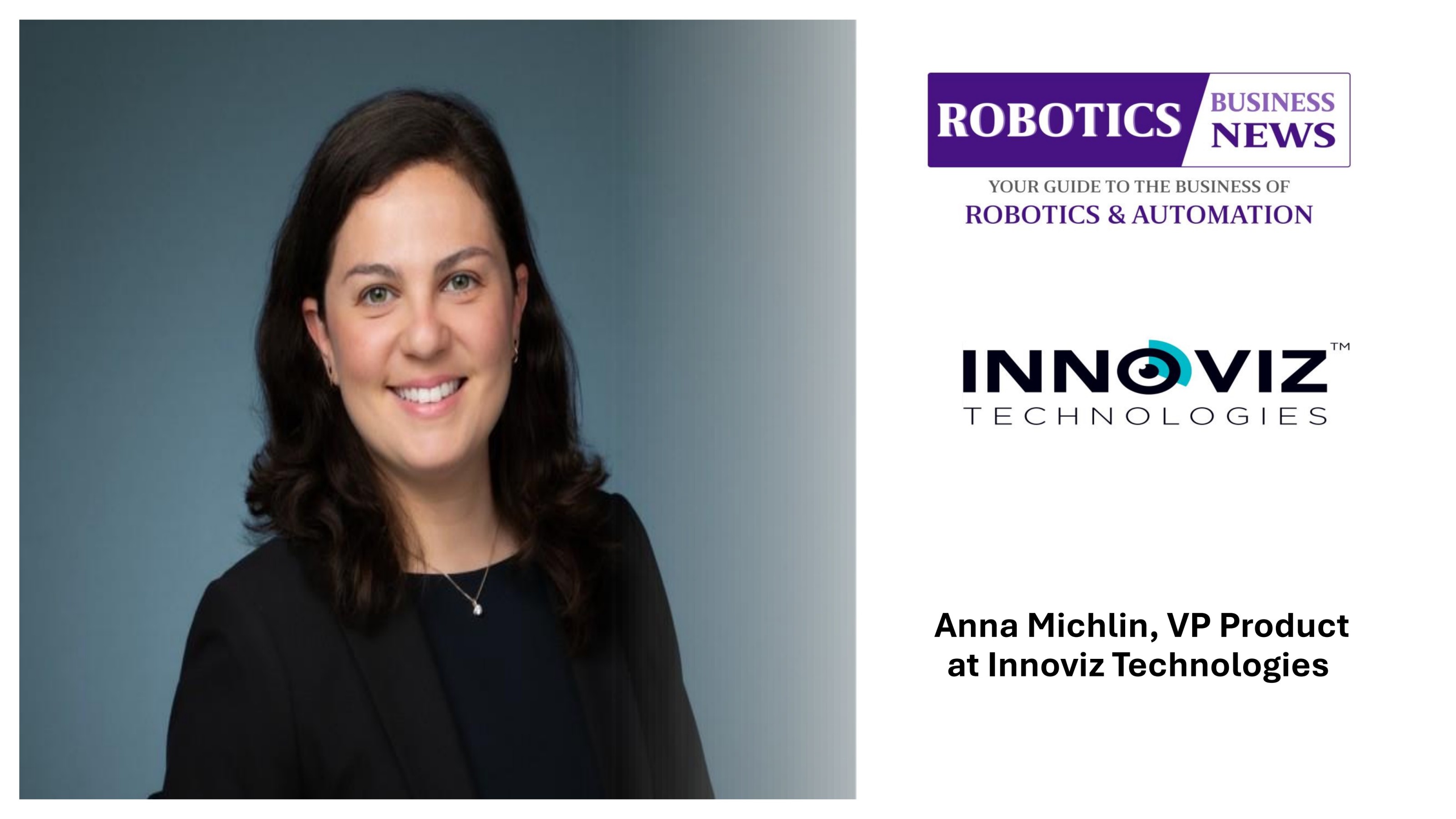
Anna Michlin discusses why perception intelligence is moving closer to the sensor, how embedded AI is reshaping autonomous driving architectures, and what OEMs demand from next-generation LiDAR partners.
As autonomous vehicle development moves from experimentation to large-scale deployment, perception systems are becoming increasingly intelligent and distributed. In this exclusive interview with Robotics Business News, Anna Michlin, VP Product at Innoviz, shares insights into the rise of smart LiDAR sensors, the role of Physical AI in vehicle autonomy, evolving OEM requirements, and how embedded perception is helping shape the future of autonomous driving and robotics.
Innoviz is moving perception intelligence directly ono the LiDAR sensor itself rather than relying entirely on centralized vehicle compute systems. Why is the industry shifting toward "smart sensors" as autonomous driving architectures mature?
I wouldn't say the industry as a whole is shifting towards compute being embedded in sensors, rather certain customers, with certain use cases, are asking for it, and we're meeting that demand because the use cases are real.
In the automotive industry, some OEMs want a sensor that delivers a standardized, safety-critical output the rest of the vehicle stack can rely on directly. For them, the case is about latency, reliability, and functional safety. Piping raw point clouds to a central processor costs milliseconds in critical decisions and adds load on vehicle networks. Moving perception closer to the sensor gives them an independent processing node that keeps functioning regardless of what's happening in the central compute stack. That matters most for the most demanding autonomous applications. But it's not every OEM as preferences vary, and plenty of programs are perfectly well served by centralized compute.
Outside automotive, the driver is completely different. In robotics and similar applications, customers are building across a huge range of use cases, and planning for some that don't even exist yet. Putting capable compute directly on the LiDAR gives those developers the flexibility to create their own applications on the edge, without being locked into someone else's stack. For them, on-sensor intelligence is about freedom to build. It's the same underlying technology, two very different reasons it matters.
The announcement describes this as "Physical AI in practice." How do you define Physical AI in the context of autonomous vehicles, and what role does embedded perception play in enabling it?
Physical AI is about bridging digital intelligence and real-world action. You're actively reasoning about the physical environment in real time, at the point of sensing, and delivering actionable outputs with real consequences. That is the distinction from simply collecting data and shipping it somewhere else for interpretation.
The progression from raw data to a classified, tracked object that the vehicle can act on is the value we're focused on. When you embed perception directly into the sensor, you're placing that intelligence as close to the physical world as possible. The sensor becomes an intelligent node making decisions about what it sees in real time.
Historically, LiDAR companies focused primarily on hardware, while perception software lived elsewhere in the autonomy stack. Why is Innoviz now expanding deeper into embedded software and sensor-level intelligence?
The push into sensor-level intelligence comes directly from listening to customers. They need sophisticated perception workloads to run on the sensor itself, as another layer to the central compute system. OEMs building at production scale want an integrated solution they can depend on in case of a safety-critical situation.
A leading autonomous driving company is already evaluating this capability with us, which tells us that what we've built is being recognized as exactly that.
OEMs increasingly want safety-critical perception outputs generated directly at the sensor level. What advantages does on-sensor perception provide in terms of latency, reliability, and functional safety?
Not every OEM we work with wants on-sensor perception, but the ones who do, the reasoning lines up on three interconnected fronts: latency, reliability, and functional safety.
From a latency perspective, when perception runs on-sensor, you eliminate the round-trip time to a central processor. In a Level 4 system, every millisecond of response time in safety-critical decisions matters, and perception needs to happen as close to the moment of sensing as possible.
With regards to reliability, on-sensor perception generates a standardized output that the vehicle stack consumes directly, and it operates independently of the vehicle's broader processing architecture. That independence means you have a perception channel that keeps functioning correctly even if other system components are under a heavy load or degraded.
Lastly, there's the impact on functional safety. The fundamental difference between Level 3 and Level 4 is the availability of human fallback. At Level 4, there's no expectation of a driver being on alert in case needed. The system must work continuously, in all conditions. On-sensor perception, operating independently from central compute and on top of it, is a core architectural building block for achieving that availability.
Autonomous driving systems are under enormous pressure to reduce compute costs, energy consumption, and architectural complexity. Could distributing intelligence across sensors fundamentally reshape future AV system design?
Reducing compute cost, energy consumption, and architectural complexity is something everyone in this market is working on, but there are a lot of different approaches being explored to get there, and honestly, each one has real potential depending on the application.
The agreement involves a leading autonomous driving technology company whose identity was not disclosed. What qualities are OEMs and AV developers prioritizing today when selecting long-term LiDAR and perception partners?
Production credibility, above everything else. OEMs and AV developers have been burned too many times by suppliers who delivered impressive demos but couldn't scale to automotive volumes, costs, or quality standards. The first questions they ask are blunt: can this sensor pass automotive-grade qualification? Can you scale from hundreds of units to hundreds of thousands? Can you meet our cost targets? Can you guarantee us that you can take on long-term contracts? Most LiDAR companies struggle to answer yes to all of those questions.
The other thing I'd add is to pick a partner who is past the pilot stage. There's a meaningful gap between a company that can run a successful demo and one that has actually shipped at scale with major OEMs. Real-world programs surface problems you cannot find in a lab, and that experience compounds and, for us, has become a competitive advantage, as we have numerous partners for L3 and now L4.
The autonomous vehicle industry has gone through cycles of hype, consolidation, and shifting timelines. How has Innoviz adapted its strategy to remain relevant as the market evolves from experimentation toward production-scale deployment?
We stayed close to our customers and evolved with them. The companies that got stuck were the ones who locked into a single roadmap and waited for the market to catch up. When OEMs told us what they actually needed to reach production on cost, qualification, integration, the kind of output their stack could consume, we adapted to match. That's how we went from a sensor supplier to a longer-term partner, first on L3 programs and now on L4. The same listening shaped our move into perimeter defense, homeland security, and intelligent infrastructure, applying automotive-grade technology where customers told us it was needed.
Hype cycles will keep coming. What keeps you relevant is being genuinely useful to the companies building real products, and being willing to change as their needs change.
Looking ahead five years, do you believe LiDAR sensors will evolve into fully autonomous perception nodes capable of independent decision support, or will centralized AI compute remain dominant in vehicle autonomy?
I'd be cautious about predicting exactly where this lands in five years, as at best it would be a guess. Our work centers on the optical engine, and as that and the AI get better, the role of the sensor in the broader system will keep expanding. But the shape of that expansion depends entirely on the application. Not every automotive use case is the same, and for robotics we have barely begun to create what is possible, and teams will continue to refine the approach based on their individual and practical needs.