Massachusetts Emerges as a Global Robotics Hub for AI, Automation and Intelligent Machines
From Boston Dynamics and Amazon Robotics to MIT, MassRobotics and a growing Physical AI ecosystem, Massachusetts is connecting robotics research, startups and industrial innovation.
Image Courtesy: Public Domain
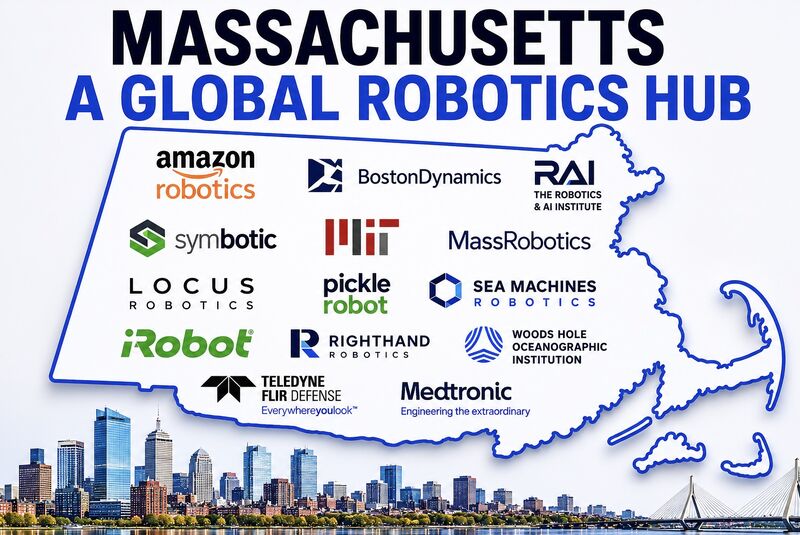
From Boston Dynamics and Amazon Robotics to MIT, MassRobotics, Symbotic, Locus Robotics and emerging Physical AI startups, the state brings together world-class research, engineering talent and commercial robotics expertise. Its ecosystem spans warehouse automation, humanoids, medical robotics, defense, marine robotics and autonomous systems—creating a powerful environment for developing and deploying the next generation of intelligent machines.
Massachusetts is emerging as a major global center for robotics, bringing together leading robotics companies, universities, research laboratories, startups, investors and industrial partners across a remarkably connected ecosystem. From humanoid robots and warehouse automation to marine robotics, medical technology, defense systems and Physical AI, the state is supporting technologies that are moving robotics from research laboratories into real-world applications.
According to MassRobotics, the Massachusetts robotics ecosystem includes more than 500 companies producing or using robotics applications across 11 markets, alongside more than 35 robotics R&D programs across 18 institutions. The ecosystem also benefits from a highly skilled workforce and supporting industries covering sensors, components and manufacturing.
A concentration of robotics leaders
The strength of Massachusetts is partly rooted in the concentration of established robotics companies and technology organizations located across Greater Boston and the wider state. The ecosystem includes names such as Amazon Robotics, Boston Dynamics, Symbotic, Locus Robotics, iRobot, RightHand Robotics, Pickle Robot and Sea Machines Robotics, alongside research institutions and organizations such as MIT, Woods Hole Oceanographic Institution and MassRobotics.
Amazon Robotics has established a major presence in Massachusetts, including its robotics facility in Westborough, where robots are developed and tested for Amazon fulfillment operations.
Boston Dynamics is also expanding its Massachusetts footprint. In June 2026, the company announced plans for a new advanced robotics and AI center in Waltham, with an investment of approximately $100 million and plans to create 1,250 jobs by 2033, according to Boston.com.
Symbotic, headquartered in Wilmington, Massachusetts, is another major example of the state's industrial robotics strength, developing large-scale warehouse automation systems designed to transform supply-chain operations.
MIT and universities create the technology pipeline
One of Massachusetts' most important advantages is the connection between robotics research and commercialization. MIT and other universities across the state have developed extensive capabilities in artificial intelligence, computer vision, autonomous systems, mechanical engineering, human-robot interaction and advanced manufacturing.
MassTech's robotics ecosystem initiative brings together industry leaders, academic experts and government innovation officials to support the continued development of the state's robotics sector. Its membership has included representatives from organizations such as Amazon Robotics, Boston Dynamics, Locus Robotics, Harvard University, UMass Amherst and MassRobotics.
This research environment has helped Massachusetts produce companies working across multiple robotics categories rather than focusing on a single application.
MassRobotics connects startups with industry
At the center of this ecosystem is MassRobotics, an independent robotics innovation hub based in Boston's Seaport District. The organization provides startups with workspace, technology resources, industry connections, investors, mentors and commercialization support. MassRobotics says its ecosystem now includes more than 500 robotics companies, while its resident startups have collectively secured billions of dollars in venture funding. The organization is also increasingly focused on Physical AI, reflecting a broader shift in robotics toward systems capable of understanding and interacting with complex real-world environments.
In 2026, MassRobotics, AWS and NVIDIA launched the second cohort of their Physical AI Fellowship, bringing together startups working across areas including agriculture, construction, renewable energy, industrial automation, retail, logistics, teleoperation and humanoid robotics.
Robotics beyond warehouses and factories
Massachusetts' robotics landscape extends well beyond traditional industrial automation. The state's ecosystem includes marine robotics, healthcare robotics, defense technology, autonomous vehicles, drones, logistics automation, consumer robotics and humanoid systems.
Woods Hole Oceanographic Institution, for example, contributes expertise in marine robotics and autonomous systems, while defense-oriented organizations and companies develop robotic technologies for challenging operational environments.
Medical technology is another important area, with Massachusetts' broader healthcare and biotechnology ecosystem providing opportunities for robotics companies developing surgical, rehabilitation and diagnostic technologies. This diversity gives the state an unusual combination of robotics research, engineering talent and potential customers across multiple industries.
The Physical AI opportunity
The next phase of Massachusetts' robotics ecosystem is increasingly connected to Physical AI—the development of intelligent systems that can perceive their surroundings, reason about physical environments and perform actions in the real world. The combination of AI research, robotics hardware, simulation, sensors, autonomous systems and industrial applications positions Massachusetts to participate in this transition. MassRobotics' collaboration with AWS and NVIDIA around Physical AI is one example of how the ecosystem is connecting startup innovation with major technology platforms.
At the same time, companies such as Boston Dynamics are advancing highly mobile robots, while warehouse automation companies including Amazon Robotics and Symbotic are applying robotics and AI to large-scale logistics operations.
A mature ecosystem facing a new challenge
Massachusetts has many of the ingredients required for robotics innovation: universities, research laboratories, established companies, startups, investors, manufacturing capabilities and specialized talent.
However, a 2024 Massachusetts Robotics Ecosystem Assessment by MassTech and SRI also highlighted a gap between the state's strong robotics R&D capabilities and startup commercialization. The report identified 186 Massachusetts-headquartered robotics companies, expanding to more than 400 when related AI, software, component and systems-integration companies are included. It also noted that Massachusetts has faced challenges in new robotics business formation and venture-capital attraction compared with California.
That challenge makes the next stage of the ecosystem particularly important: converting research excellence into scalable companies, products and deployments.
Massachusetts' robotics story is still evolving
Massachusetts' position in robotics has been built over decades, but the current wave of AI, humanoid robotics, autonomous machines and Physical AI is creating a new opportunity. The combination of Boston's technology community, MIT and other research institutions, MassRobotics, established robotics companies and a growing startup ecosystem gives the state a strong foundation for the next generation of intelligent machines.
From warehouse robots and robotic dogs to marine systems, medical technologies and humanoids, Massachusetts demonstrates how a regional ecosystem can connect research, entrepreneurship and industrial deployment.
For the global robotics industry, Massachusetts is not simply a place where robots are developed—it is becoming an increasingly important environment where robotics technologies, AI and real-world applications converge.