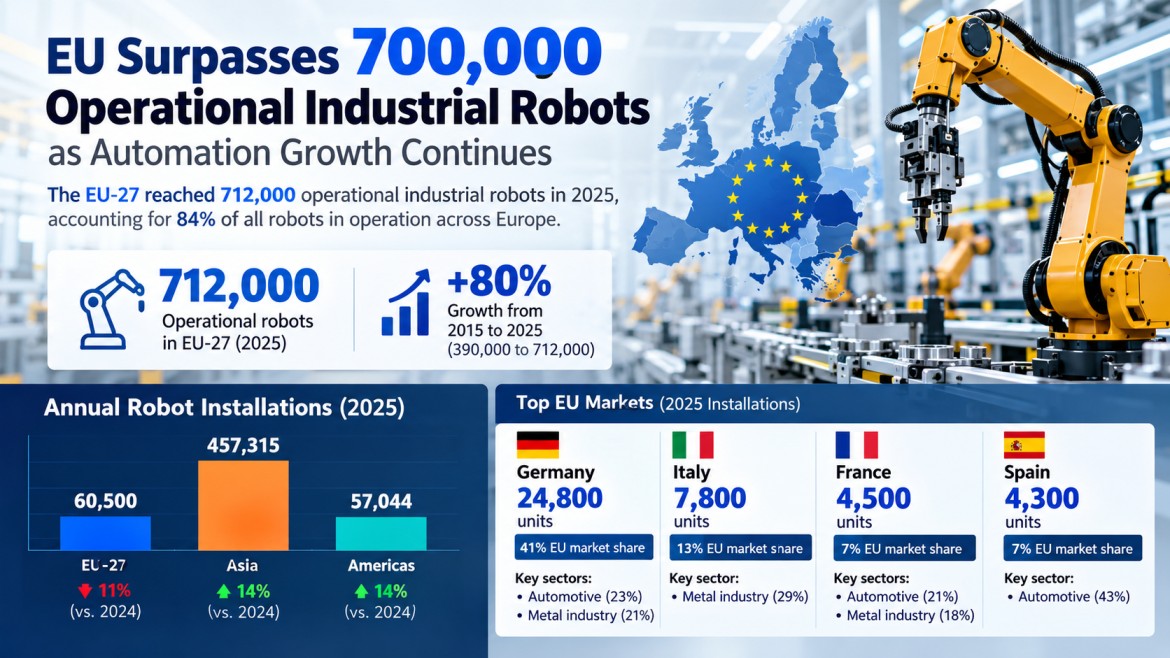
The European Union (EU-27) has surpassed the milestone of having 700,000 operational industrial robots in 2025, accounting for 84% of the total number of robots in operation across Europe. This is according to the World Robotics 2026 Industrial Robots report, presented by the International Federation of Robotics (IFR).
“The European Union's manufacturing sector has invested significantly in automation: From 2015 to 2025, the number of operational robots in the member states grew by more than 80%, from 390,000 to 712,000 units,” says Jane Heffner, President of the International Federation of Robotics.
Annual installations 2025
In terms of annual installations, the long-term momentum is positive, with a 3% compound annual growth rate from 2020 to 2025. However, Europe is not investing as fast as Asia and North America. In the short term, the EU's market development experienced an 11% contraction in 2025: Total installations fell to 60,500 units. Asia installed 457,315 units, up 14% year-over-year, and in the Americas, installations hit 57,044 units, up by 14%.
Top EU Markets
Germany is the largest robot market in the EU and the fifth-largest globally. 24,800 industrial robot installations account for 41% of the total EU market. The automotive sector continues to serve as a primary pillar, driving 23% of total German demand followed by the metal industry with a share of 21%.
Italy remains second with a share of 13%, installing 7,800 units. Demand remains anchored by strong traditional performance in the metal industry with a share of 29% as the main customer of industrial robots.
France and Spain follow, both with an EU market share of 7%. France installed 4,500 industrial robots, and continues to invest across automotive, with a national share of 21%, and the metal industry, with a share of 18%. Spain installed 4,300 industrial robots in 2025. The country's automation continues to benefit from its status as Europe's second-largest automotive producer, with a national market share of 43%.