FMC³ Robotics Advances Industrial Embodied AI Through Two Factory PoCs
FMC³ Robotics is testing mobile material handling and battery electrode processing to advance adaptable AI-powered industrial robot capabilities. Pasted markdown(20261102-151041)
Image Courtesy: Public Domain
FMC³ Robotics is advancing two industrial proof-of-concept projects. One focuses on mobile material handling at a consumer electronics manufacturing plant; the other on processing battery electrode sheets at a battery cell production site. Both PoCs address work that remains highly repetitive and physically demanding in factories, yet is difficult to automate flexibly with “traditional” automation technology.
FMC³ Robotics is an industrial embodied AI company founded in Bavaria, Germany with offices in Ingolstadt and Shanghai. The company focuses on how robots acquire and continuously improve task capabilities in real production environments. One of its core products is an embodied AI Agent Platform for industrial robots connecting data, simulation, training, validation, and deployment in a closed feedback loop. This enables robots to develop the AI Brain capabilities required for specific tasks while keeping the path from data acquisition to development to factory deployment traceable.
Traditional automation remains indispensable for long-running, high-volume, highly standardized production. The challenge in many factories today is that batch sizes are shrinking, changeovers are increasing, product variation is accelerating, and most material-handling operations still depend on manual work. Fixture adjustments and equipment reprogramming consume significant engineering time, while material transport and machine loading and unloading are highly repetitive, physically demanding, and increasingly difficult to staff.
Two Factory PoCs Test the Same Class of Robot Capabilities
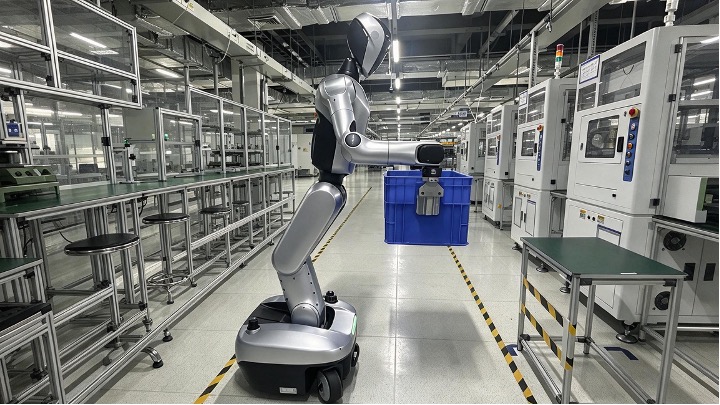
At a consumer electronics manufacturing plant, FMC³ Robotics is advancing an industrial PoC involving a wheeled robot, with delivery by the end of October 2026. Under controlled test conditions, the robot is being tested on a continuous sequence of tasks: picking up a bin, transporting it to the production area, positioning itself beside the target equipment, and placing the bin at a designated point on the production line.
The difficulty lies not in any one action, but in the factory environment around the robot. The site handles multiple products and bins of different sizes, and neither the aisles nor the equipment were redesigned around the robot. Fixed automation typically serves a defined workstation, container, and product. A mobile manipulator, by contrast, must serve different workstations and changing production requirements while minimizing dedicated automation areas and extensive line modifications.
At another production site, FMC³ Robotics is advancing a PoC for processing battery electrode sheets. The task is currently performed by a worker, who picks up the electrode sheets from a side table, transfers them to the corresponding tray, and returns the fixture to its home position. The project is intended to have a robot take over this step by picking, transporting, precisely placing, and positioning the electrode sheets. Because the task interfaces directly with existing equipment and tooling, the robot must control its grasp pose, placement position, and sequence of operations.
The two projects emphasize different aspects of the same technical problem. The first requires a mobile manipulator to navigate an existing facility and serve the production line. The second focuses on operations within a defined equipment area, placing greater emphasis on grasping, alignment, and coordination with the process sequence. Together, they test whether a robot can interpret different materials, workstations, and operation sequences; complete picking, transport, alignment, and placement; and adjust its actions to deviations observed on site without requiring extensive production-line modifications.
Both projects are currently at the industrial PoC stage. FMC³ Robotics aims to verify not only whether individual actions can be completed, but also whether the models, robot platform, and shop-floor processes can work together as a repeatable system. Metrics such as cycle time, positioning deviation, and continuous operating time will also help the team assess this.
The Data Loop Behind the AI Agent
At the same time, the two PoCs are testing the operating model behind FMC³'s embodied AI Agent Platform: a data loop that connects task capture, simulation, training, validation, deployment, and feedback from operations. The loop can draw on multiple types of data. At this stage, FMC³ Robotics places particular emphasis on task-relevant physical-world data because many shop-floor details will be lost when a factory task is reconstructed in another environment.
There is more to a factory task than a motion trajectory. The sequence of operations, how people make physical contact with objects, how deviations are recognized, what corrective actions are taken, and what quality result is achieved all help determine whether a robot has genuinely learned the task. FMC³ Robotics believes that only by preserving this context can training data support robot capabilities that can be validated in a factory.
“The real shortage is not data in general. It is qualified physical-world data that reflect how a task is actually performed in a certain environment: the movement, physical interactions, process sequence, quality outcomes, and also the errors and corrections.” Dr. Joachim Fetzer, President of Europe, FMC³ Robotics
FMC³ Robotics therefore places data acquisition within the production task itself—bringing the “gym” to the manufacturing site. Workers can continue their regular work without reenacting the task solely for data collection. As they work, the system records first-person visual and depth information, body and hand movements, task sequences, and tactile information (where needed). The resulting data capture both the task itself and the deviations and corrections that arise during execution.
At the system level, FMC³'s approach is an integrated system built on two complementary pillars: the Industrial Embodied AI Agent Platform and the standardized data infrastructure planned through the Data JV. The Agent Platform develops task-specific robot capabilities, while the planned Data JV infrastructure is intended to provide the shared data foundation, standards, and governance needed to extend the data loop across factories and applications.
Within this integrated system, FMC³ calls the toolset that supports the data loop the Doceo Data System. Doceo RealCap combines smart camera headsets, external cameras, and touch gloves (if needed) to capture multimodal information. Doceo Hub synchronizes different data streams, fuses multiple perspectives, and supports recording, playback, annotation, and data management. As an FMC³ tool, Doceo Hub is designed to run on or connect to the planned Data JV infrastructure. Supported by Vector Informatik’s data-infrastructure and cloud technologies, Doceo Cloud is designed to operate on this planned infrastructure and support data ingestion, automatic labeling, curation, training, simulation, and testing. Doceo Driver then connects the resulting capabilities to different robot platforms and control systems.
Traceability between data and capabilities is particularly important in this workflow: what type of task demonstration produced a given action, under what conditions a capability was trained and tested, and on which robot and in what environment it was validated. For industrial customers, these relationships provide important evidence when deciding whether a capability is ready to advance beyond the PoC stage.
Taking Robot Skills Beyond a Single PoC
A single PoC can validate one task chain, but extending the data loop across factories and applications also requires standardized data infrastructure and a governance framework. To build this foundation, Vector Informatik, PEM Motion, and FMC³ Robotics will establish a joint venture in Germany focused on data infrastructure for industrial embodied AI. FMC³ will contribute its Industrial embodied AI Agent Platform and task-specific data acquisition technology. PEM Motion will contribute production engineering and industrialization expertise, while Vector Informatik will provide standardized data and communication protocols, data governance, data compliance know-how as well as smart data loggers with Edge AI support. Under the planned architecture, the data will be managed through Vector SDX Cloud, with Germany-based cloud services such as STACKIT Cloud or Deutsche Telekom Cloud available depending on customer requirements.
The collaboration is intended to connect data acquisition and processing, model training, simulation-based validation, real-world deployment, and feedback from industrial operations.
Only when these stages and shop-floor feedback form a traceable chain can industrial experience drive further capability improvement and be converted into reusable robot skills.
Making the Next Deployment Faster
FMC³ Robotics aims to use this foundation to progressively develop a platform for self-learning and iteration: robot systems would identify areas for improvement from task outcomes, determine what additional data are needed, and return updated capabilities to the site for validation. As reusable skills accumulate, this process could shorten deployment cycles for new tasks and environments, helping robots adapt more quickly to high-mix, low-volume manufacturing and frequent changeovers.
This is also what FMC³ Robotics means by “moving beyond dedicated robot training facilities”: making the factory a place for continuous learning and validation, where experience gained from each deployment provides a foundation for subsequent applications.
At present, the PoCs are the starting point for testing this direction. They will help FMC³ assess whether the same embodied AI Agent can use the data loop to develop reliable, task-specific AI Brain capabilities. Further testing will determine how these skills can be reused across different settings to shorten the time required for subsequent deployments. That will be critical to moving from validation of individual tasks toward scaling industrial applications.