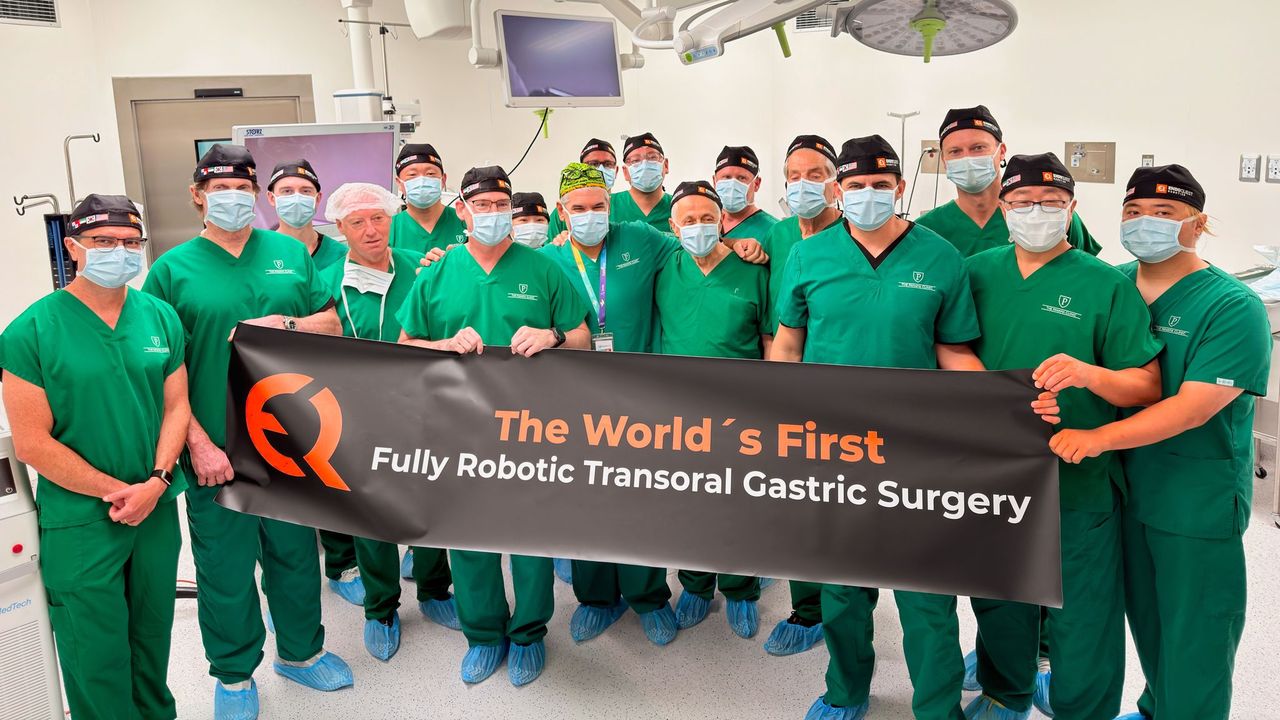
EndoQuest Robotics Performs World's First Fully Robotic Transoral Gastric Reconstruction Procedures
EndoQuest completes two incision-free robotic gastric reconstruction procedures using its ELS System, advancing flexible robotic surgery and minimally invasive bariatric treatments.
Image Courtesy: Public Domain
- Two fully robotic transoral gastric reconstruction procedures – the first of their kind worldwide – have been performed entirely through the mouth, without external incisions
- The procedures build on an established endoscopic treatment for weight regain and refractory dumping syndrome following gastric bypass surgery
- EndoQuest’s robotic system is designed to give physicians greater control when suturing stomach tissue, potentially improving the precision and durability of less invasive procedures
EndoQuest Robotics, Inc., developer of flexible robotic technology for endoluminal procedures, announced the successful completion of two robotic gastric reconstruction procedures performed entirely through the mouth, using the company’s Endoluminal Surgical (ELS) System.
The procedures mark the world's first fully robotic transoral gastric procedures and the first clinical use of the ELS System in the upper gastrointestinal (GI) tract. The approach involves using robotic instruments passed through the mouth to reconstruct stomach tissue from within, without external incisions. The robotic transoral gastric reconstruction approach is the first in a planned series of next-generation procedures EndoQuest is developing to expand the potential applications of flexible robotic surgery. It allows physicians to independently control two robotic instruments inside the stomach without the need for external incisions, enabling more precise suturing of stomach tissue.
The procedures were performed at The Panama Clinic in Panama City, Panama, led by Dr. Todd Wilson, with local principal investigator Dr. Richard Altieri Pérez. Dr. Wilson serves as EndoQuest Robotics’ Chief Medical Officer and Chairman of the International Advisory Board and is Professor of Surgery at McGovern Medical School at UTHealth Houston. Dr. Altieri is a general surgeon at The Panama Clinic who specializes in minimally invasive and robotic surgery, with a particular focus on bariatric and metabolic procedures.
“These cases demonstrate a fundamentally new robotic endoluminal gastric reconstruction,” said Dr. Wilson. “We can bring basic surgical technique directly to the target, without external incisions. This opens up vast opportunities to conduct direct, durable interventions that aren’t practical or even possible today. It was especially meaningful to be joined in Panama by Drs. Fred Moll and Santiago Horgan, whose pioneering work helped shape the fields of robotic and natural orifice surgery, and by Drs. Mohamed Othman and Michel Kahaleh, whose leadership is helping define the future of endoluminal surgery.”
Potential new approach to long-term challenges following gastric bypass surgery
Gastric bypass surgery is an established treatment for obesity, but some patients later experience weight regain or other clinical conditions such as refractory dumping syndrome – a condition in which food moves too quickly from the stomach into the small intestine, causing symptoms such as nausea, abdominal pain and diarrhea. One contributing factor can be widening of the opening between the gastric pouch and small intestine.
An existing procedure called transoral outlet reduction (TORe) can help address these problems. It is performed using an endoscope – a flexible tube with a camera – with a suturing system through the mouth. Conventional flexible endoscopes commonly provide a single working channel for one instrument or accessory at a time and do not offer independently articulated, two-handed control.
Physicians use the endoscope and suturing system to place stitches that reduce the size of the opening and, when appropriate, the gastric pouch created during the initial gastric bypass surgery, without making external incisions.
Research has shown that TORe can provide sustained weight-loss benefits, although results vary between patients. A five-year study demonstrated sustained weight loss yet also found that nearly 40% of patients received additional weight-loss treatment during follow-up.[1]
The new robotic approach builds on this established procedure, with the aim of giving physicians greater control and precision when placing stitches into deeper layers of stomach tissue. In a previous study comparing different suturing techniques for TORe, full-thickness suturing was associated with greater weight loss at six and 12 months than more superficial suturing.[2]
“It is an honor for Panama and our clinical team to participate in this historic milestone,” said Dr. Altieri. “Conducting this first-in-human study here reflects Panama’s established strength in rigorous clinical research and its commitment to advancing surgical innovation. The future of bariatric care will increasingly be shaped by less invasive, technology-enabled procedures, and we are proud to help advance that future.”
The ELS System is designed to give physicians greater control during complex procedures performed through the body's natural openings. Its two-handed robotic instrument control allows physicians to manipulate deeper tissue layers, apply tension and perform precise full-thickness suturing, capabilities that can be challenging to achieve using conventional flexible endoscopy and are intended to support more consistent and durable procedures.
“Having also been present for the first cases performed in EndoQuest’s lower GI PARADIGM Trial, what I witnessed in Panama represents a major expansion in the clinical reach of robotic surgery,” said Dr. Fred Moll, Chairman of the Board of EndoQuest Robotics and co-founder of Intuitive Surgical and Auris Health. “Designing a flexible system that can operate within the constraints of endoscopy while delivering the precision required for surgery is an extraordinary engineering challenge. The EndoQuest team has demonstrated the technical expertise required to develop an endoluminal platform capable of supporting a growing range of procedures across the GI tract, making this an exciting milestone not only for the company, but for healthcare more broadly.”
EndoQuest is also developing other robotic procedures aimed at treating obesity and related conditions without external incisions. One example is robotic transoral gastric plication, an experimental technique that uses stitches placed from outside the stomach to reduce its capacity, while all access is obtained through the mouth without external incisions. In a preclinical study conducted at Brigham and Women’s Hospital, the technique achieved a mean gastric volume reduction of 70%.[3]
“When I began exploring natural orifice surgery in the early 2000s, the instruments available to us were rudimentary, which limited control and tissue handling capabilities required for complex procedures,” said Dr. Santiago Horgan, Professor Emeritus of Surgery at the University of California, San Diego School of Medicine. “The vision of performing surgery without external incisions was compelling, but the technology was not yet ready. Flexible robotics now offers a way to overcome those longstanding limitations, close the gap between endoscopy and surgery, and ultimately improve outcomes for patients.”
Next steps for EndoQuest
The Panama procedures build on EndoQuest’s wider clinical development program. In July 2026, the company completed enrollment in its PARADIGM Trial, a US multicenter study evaluating the ELS System in procedures to remove abnormal tissue from the lower digestive tract.
The ELS System has also been accepted into the FDA’s Safer Technologies Program (STeP), which is designed to expedite the development, assessment and review of medical devices reasonably expected to significantly improve the safety of currently available treatments. To EndoQuest’s knowledge, the ELS System is the only surgical robotic platform currently under active development to have been accepted into the program.
EndoQuest is preparing a De Novo Classification Request to the US Food and Drug Administration (FDA) and is targeting a 2027 US launch, subject to FDA marketing authorization.
“These procedures expand the ELS System beyond the lower GI application evaluated in PARADIGM and mark the beginning of a new phase for EndoQuest,” said Eduardo Fonseca, Chief Executive Officer of EndoQuest Robotics. “They reflect years of clinical development that have enabled us to refine the platform to meet the unique technical demands of robotic endoluminal surgery. The accumulated clinical experience provides EndoQuest with a strong foundation for building a differentiated portfolio of upper GI and endobariatric procedures, substantially expanding the clinical and commercial value of the ELS System.”