Pudu Robotics Demonstrates Embodied AI at Davos Tech Summit 2026
Pudu Robotics showcased autonomous robots across retail, hospitality, and public spaces, highlighting scalable embodied AI applications in real-world operations.
Image Courtesy: Public Domain
Pudu Robotics , a global leader in commercial service robotics, will demonstrate how autonomous robots create real added value in operations at Davos Tech Summit 2026 , one of Europe's leading events on the future of physical AI.
Under the motto "Touching Intelligence," this year's summit focuses on how embodied intelligence moves beyond technological breakthroughs into practical application. As part of the event's Robot City initiative, robots will be deployed throughout Davos in everyday commercial environments, giving industry leaders, customers, and the public the opportunity to observe autonomous systems performing practical tasks in real-world operating settings.
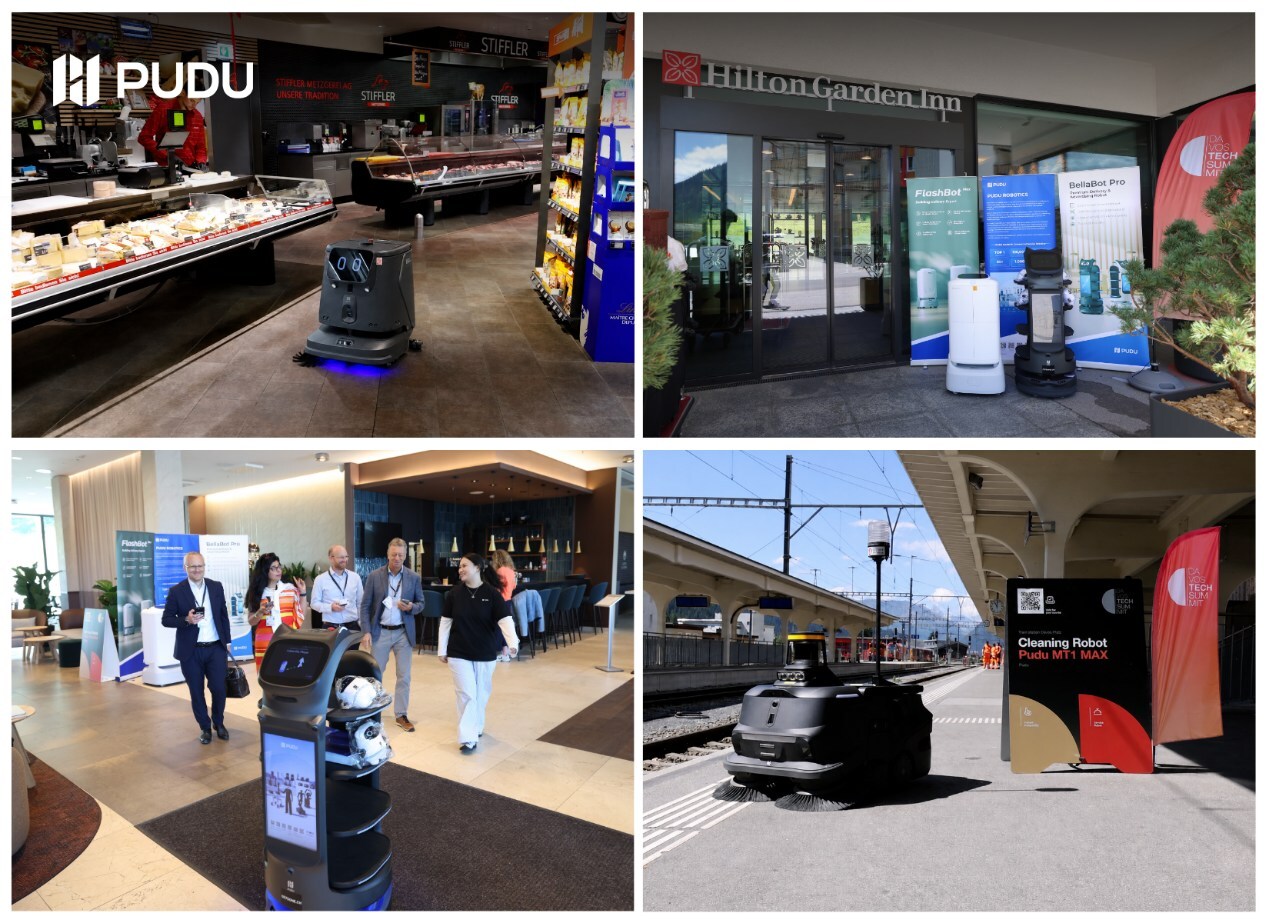
As one of the featured robotics companies participating in Robot City, Pudu Robotics deployed four robots at three locations in Davos , demonstrating how embodied intelligence already creates measurable added value in everyday business scenarios.
Four robots in three real-world scenarios
As part of the Robot City program, visitors can take part in guided tours to observe Pudu robots performing everyday tasks in retail, hospitality and public infrastructure.
- Cleaning at the SPAR supermarket
In a SPAR supermarket, the PUDU CC1 Pro performed autonomous floor cleaning during normal business hours. The robot navigated through customer traffic, shelf layouts, and changing aisle conditions, combining image processing, LiDAR, and AI-based perception to dynamically plan routes and continuously evaluate cleaning results. Equipped with a rear-facing AI camera, the CC1 Pro can detect remaining stains after cleaning and automatically perform targeted touch-ups. This allows it to verify that the task is complete, rather than simply following a predefined route.
- Hotel services at the Hilton
At the Hilton Davos, FlashBot Max and BellaBot Pro work together to support both internal delivery processes and guest services. FlashBot Max autonomously transports materials between floors by connecting to the building's elevator system, while BellaBot Pro greets guests and delivers food and drinks using autonomous navigation and multimodal interaction. In hotel operations, robots must coordinate several interconnected processes—from picking up orders and accessing elevators to interacting with guests—and adapt to unexpected changes throughout the workflow.
- Cleaning of public areas in front of the train station in Davos
In the station forecourt in Davos, the PUDU MT1 Max demonstrated autonomous cleaning in public outdoor areas and semi-open spaces. Using 3D perception, LiDAR, and multi-sensor fusion, the robot navigated safely through busy environments, adapting to pedestrian movements and changing environmental conditions. Its IP54 protection rating and active rain avoidance further enhanced its operational reliability in outdoor settings.
Although each robot covered different operational requirements, together they demonstrated a common capability: embodied AI that can independently perceive, understand, adapt to, and execute tasks in the real world.
The technology behind the scaling: One brain, many embodiments
Reliable robot deployment in various industries and urban-scale environments requires more than advanced hardware – years of practical experience and an AI architecture designed for scalability are crucial.
Instead of developing isolated AI stacks for individual product lines, Pudu has built a unified architecture for embodied AI, at the core of which are the company's proprietary base model PuduFM and the general-purpose agent platform PuduAgent . Thanks to this shared intelligence, robots from various categories—including service robotics, commercial cleaning, industrial logistics, and general embodied AI—can leverage a common cognitive framework for environmental perception, task execution, and multi-agent collaboration.
The architecture significantly reduces deployment complexity, improves fleet coordination, and accelerates localization in international markets. As a result, customers receive scalable automation solutions instead of individual robotic devices.
Practical application accelerates the development of embodied AI.
This technology strategy has fueled Pudu's rapid global expansion. As of 2026, the company has shipped more than 130,000 robots worldwide and serves customers in 85 countries and regions , with international markets accounting for more than 80% of total revenue.
During these long-term deployments, the robots are exposed to a wide range of practical challenges – from changing pedestrian flows and temporary obstacles to varying building infrastructures, weather conditions, and local operational requirements. Following legally compliant data collection, analysis, and model optimization, this experience is transformed into reusable capabilities that can be applied to other products and customer scenarios.
This continuous feedback loop is already leading to commercial scaling. In June 2026, Pudu Robotics and its regional partner Robobee announced a partnership with the Swiss retailer Denner to deploy 200 PUDU CC1 cleaning robots across its store network , increasing operational efficiency through human-robot collaboration. Together with "Robot City," these deployments demonstrate how embodied AI proves its worth in both commercial operations and public urban environments.
From demonstrations to practical application
At Robot City, Pudu Robotics demonstrated that the future of embodied AI is not determined by isolated demonstrations, but by its reliable deployment in real-world environments. With a common AI foundation for various robot types, the company is further integrating embodied AI into the daily operations of diverse industries worldwide.