Rendezvous Robotics Raises $20 Million to Advance Self-Assembling Spacecraft
The oversubscribed seed round will fund next-generation spacecraft development, flight demonstrations and team expansion as Rendezvous prepares for a 2028 mission to autonomously assemble and reconfigure spacecraft tiles in orbit.
Image Courtesy: Public Domain
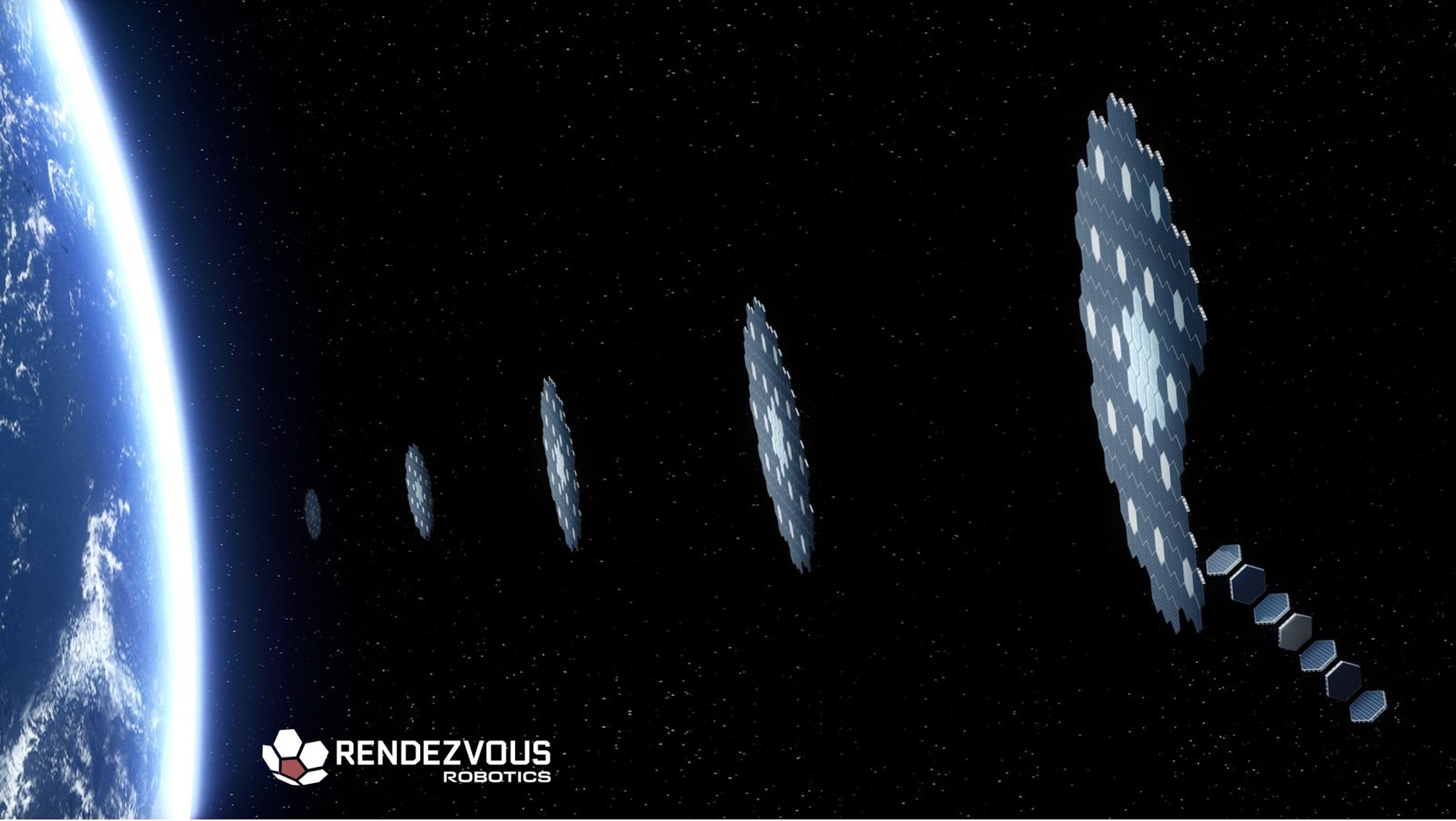
Rendezvous Robotics, the company building spacecraft that assemble themselves in orbit, has raised $20 million in an oversubscribed seed round. MaC Venture Capital and Toyota Ventures led the financing, which comes as the company prepares for a first-of-its-kind mission in 2028, when seven independent spacecraft tiles will autonomously join to form a single spacecraft, separate and assemble again into a different configuration.
The financing marks Rendezvous' first priced funding round and includes significant participation from the University of Michigan Endowment, new investment from Astera (co-founded by Jed McCaleb), Industrious Ventures, and continued support from existing investors Aurelia Foundry, ATX Venture Partners, and Mana Ventures, among others. The capital will support development of the company's next-generation spacecraft, flight demonstrations and team expansion.
Most spacecraft are designed around what fits inside a rocket fairing. That constraint forces engineers to make tradeoffs in power generation, compute, antenna size and heat dissipation before launch, even as demand for all of these continues to grow. Rendezvous is rewriting the rules of how spacecraft are built. Its spacecraft launch as compact, independent modular tiles, that autonomously maneuver, align and connect in orbit. The modular design allows spacecraft to be assembled into larger structures and reconfigured after launch to adapt to new missions.
From an MIT Lab to Orbit
Rendezvous builds on nearly a decade of research that began with TESSERAE, a modular self-assembly technology invented by Dr. Ariel Ekblaw at MIT and further developed through the Aurelia Institute, which Ekblaw founded. Earlier generations have flown aboard Blue Origin's New Shepard rocket and on two missions to the International Space Station (ISS), providing the foundational proof of the underlying technological concept in microgravity.
"The vision behind TESSERAE was never simply to connect tiles in space. It was to rethink how we build beyond Earth," said Dr. Ariel Ekblaw, Co-Founder and Board Chair of Rendezvous Robotics. "For decades, the way we build spacecraft has been shaped by what we can fit inside a rocket. We're challenging that constraint. What began as an experiment in self-assembly is now becoming a new way to build spacecraft in orbit."
The company is now developing a new generation of larger, independently operating spacecraft tiles, with ground demonstrations underway to validate autonomous movement, alignment and assembly. A planned parabolic flight campaign in November 2026 will further test electromagnetic actuation and mobility in microgravity. These efforts are leading to Rendezvous' low-earth demonstration, scheduled to launch aboard a reserved rideshare no earlier than April 2028. The mission will feature fully autonomous assembly and reconfiguration of independently deployed Rendezvous spacecraft tiles in free space, demonstrating how spacecraft can change their physical structure after launch without external robotic assistance.
"We're changing what it means to build a spacecraft," said Joe Landon, Co-Founder and CEO of Rendezvous Robotics. "Imagine spacecraft with megawatt-scale power generation, enormous communications and sensing apertures, and the ability to expand or reconfigure as mission needs change. Rendezvous is building spacecraft on an entirely different scale, with the ability to add capabilities after launch and take on missions that simply aren't practical with the way we build spacecraft today. We've brought together a world-class engineering team with the experience, ingenuity and technical expertise to make that vision a reality."
Separately, a final ISS demonstration of fifth-generation TESSERAE technology is scheduled for December 2026, when 32 tiles will autonomously assemble into a three-dimensional structure in a controlled microgravity environment. The experiment marks the culmination of the earlier TESSERAE research program as Rendezvous advances the larger, free-flying spacecraft architecture.
Investors Back a New Approach to Spacecraft Design
MaC Venture Capital
"The most interesting companies challenge assumptions that an entire industry has learned to work around," said Michael Palank, Managing General Partner at MaC Venture Capital. "Rendezvous is doing exactly that. Instead of finding better ways to package a spacecraft for launch, they're rethinking how spacecraft are built in the first place. The team has the technical foundation, experience, and ambition to pursue something genuinely different."
Toyota Ventures
"What stood out to us is that autonomy isn't an added feature. It's fundamental to how Rendezvous is designing its spacecraft," said Chris Abshire, Partner at Toyota Ventures. "The ability for individual modules to maneuver, connect, and eventually reconfigure in orbit could create an entirely new set of options for spacecraft designers and operators. Toyota Ventures sees significant potential in the combination of robotics, modularity, and autonomous control."
University of Michigan Investment Office
"We've followed Ariel's research with great interest and have tremendous confidence in her vision and the team she's helped build," said Daniel Feder, Senior Managing Director at the University of Michigan Investment Office. "Bringing breakthrough technology out of the research environment and into practical use takes both technical discipline and long-term commitment. Rendezvous has a strong foundation of research behind it, and we're excited to support the next stage of its development."