OpenCxMS Files 15 Patent Applications for Hardware-Enforced AI Safety Standard in Autonomous Robotics
New Standardized Autonomous Safety Module (SASM) introduces independent hardware safety processor designed to prevent AI systems from overriding physical-world safeguards.
Image Courtesy: Public Domain
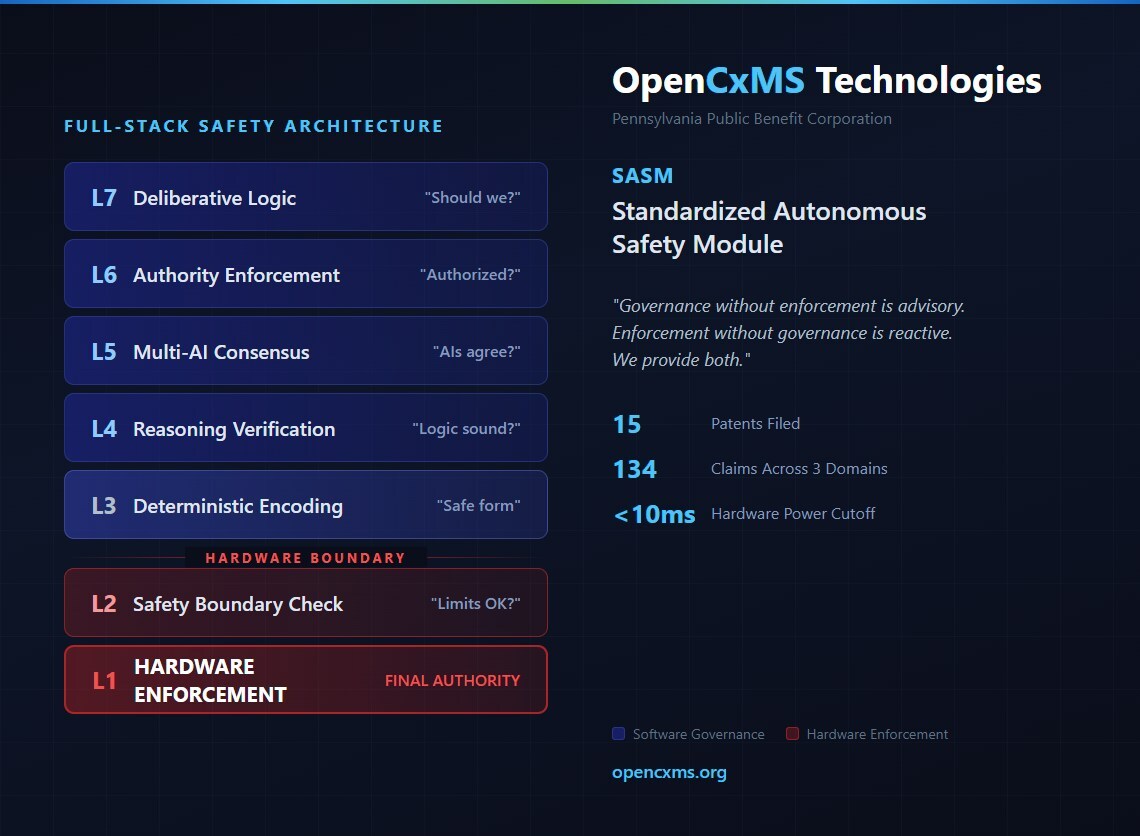
OpenCxMS Technologies, Inc., a newly formed Pennsylvania Public Benefit Corporation, announced it has filed 15 provisional patent applications with the U.S. Patent and Trademark Office covering 134 claims across three domains: software governance, hardware enforcement, and supporting commercial infrastructure.
The filings, made between February 4 and February 17, 2026, describe the Standardized Autonomous Safety Module (SASM) — an open hardware and software standard that places a dedicated safety processor between an AI system and the physical world. The AI cannot override it. The safety processor operates on its own power rail, independent of AI compute, and can cut power to AI systems in under 10 milliseconds without any software command.
"Every AI safety system I've been able to find is software watching software," said Robert S. Briggs II, sole inventor and founder. "That's a guard dog that reports to the burglar. We put the safety enforcement in hardware — below the software layer — where no AI can reach it. That's not a feature. That's physics."
The Standard That Doesn't Exist Yet
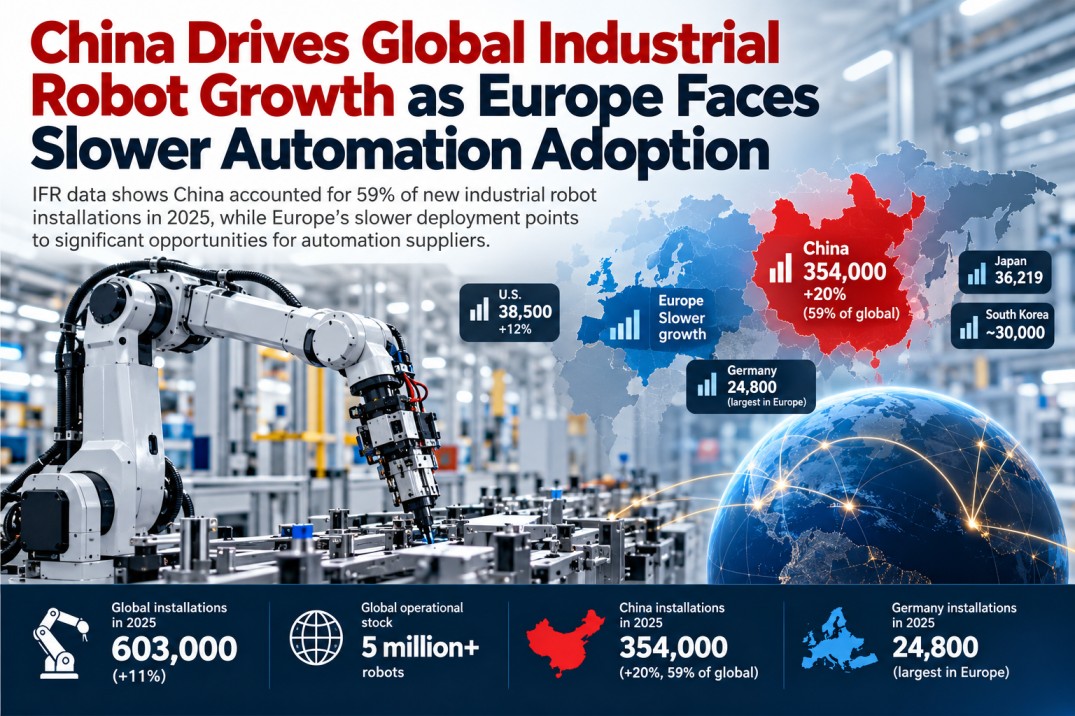
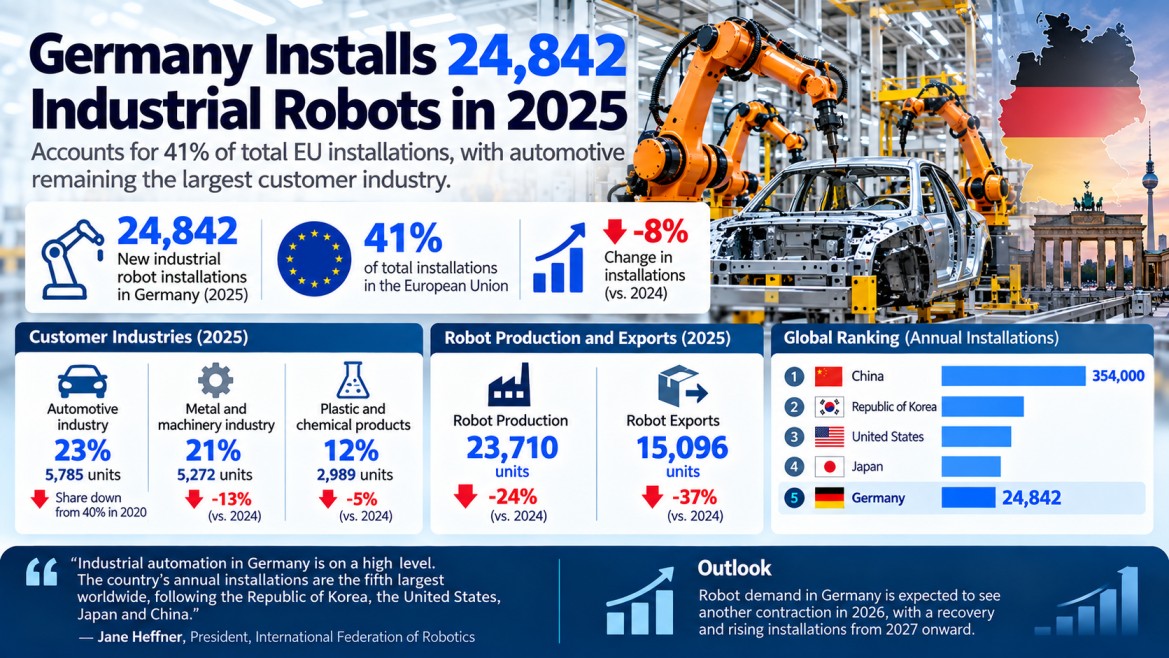
The autonomous robotics industry is projected to exceed $60 billion by 2030. Hundreds of thousands of industrial robots are deployed annually. Humanoid robots from multiple manufacturers are expected to enter commercial service beginning in 2026. Yet no published, open standard exists for hardware-enforced AI safety across robot platforms.
The EU AI Act, fully applicable August 2, 2026, mandates auditable decision records, transparent operation, and effective human oversight for all high-risk AI systems — including autonomous robots. Non-compliance carries fines of up to 7% of global annual revenue.
"There are brilliant companies building incredible robots," said Briggs. "What's missing is the safety layer that works across all of them. We're not competing with robot manufacturers — we're building the safety infrastructure they all need."
ATX for Robot Brains
In 1995, Intel published the ATX specification and created an interchangeable ecosystem for PC components. Before ATX, every manufacturer had proprietary form factors. After ATX, any motherboard fit any case.
The SASM specification applies the same principle to robot safety modules: three standardized form factors — from a deck-of-cards-sized module for drones to a hardcover-book-sized unit for humanoid robots — sharing a universal connector interface. Any compliant brain plugs into any compliant robot body.
Key architectural features include:
- Dedicated safety processor on an independent power rail, completely separate from AI compute
- Hardware power gating — physical power interruption in under 10 milliseconds, no software override possible
- Multi-vendor AI consensus — up to nine different AI models from different vendors must reach majority agreement before any physical action
- Human-readable audit trail — every decision recorded in plain-text files any inspector can open without special tools
15 Patents. 134 Claims. 3 Domains. 1 Inventor.
The portfolio spans the complete technology stack: nine software patents (72 claims) covering safety interlocks, multi-vendor consensus, transparent reasoning verification, fleet coordination, and persistent AI memory; four hardware patents (33 claims) covering the integrated brain system, safety-first power gating, the universal connector, and the standardized form factor; and two supporting commercial infrastructure patents (29 claims) covering tokenized equity instruments and value creation systems.
Briggs is sole inventor on all 15 applications. He built the portfolio using AI tools for research, drafting, and organization — and is transparent about it.
"I use AI the same way an architect uses CAD," said Briggs. "Every design decision and every safety requirement was mine. AI helped me document it faster. The interesting part is that during development, the AI assistant itself demonstrated the exact failure mode this company exists to solve — it had the right information in its files but used a stale version instead. It didn't verify. That's a minor embarrassment when you're writing a press release. It's a catastrophe when an AI is controlling a robot."
A Public Benefit Corporation by Design
OpenCxMS Technologies is incorporated as a Pennsylvania Public Benefit Corporation — a corporate structure that legally binds the company's safety mission into its charter. The safety mission cannot be overridden by profit motive.
"We chose this structure on purpose," said Briggs. "When the pressure is to ship fast, safety is what gets cut. A PBC means our mission is in the charter, not just the marketing. That's the kind of company I want to build, and the kind of company I'd want making the safety module for a robot working next to my family."
The company's development process is itself a proof-of-concept: over 100 documented AI engineering sessions, hundreds of version-controlled commits, and prior art searches against more than 200 existing patents — all tracked in the same human-readable format the SASM produces.