NVIDIA Launches Open-Source Physical AI Skills to Accelerate Robotics, Autonomous Vehicles and Industrial AI
New agent-ready tools and physical AI skills help developers automate simulation, training, evaluation and deployment workflows across robotics, autonomous driving, healthcare and industrial digital twins.
Image Courtesy: Public Domain
- NVIDIA releases a major open source collection of physical AI agent skills and tools spanning NVIDIA Omniverse, Cosmos, Alpamayo and Metropolis for robotics, autonomous vehicles, vision AI and industrial digital twins.
- New physical AI skills turn complex physical AI training, evaluation and deployment workflows into repeatable, optimized and agent-executable instructions.
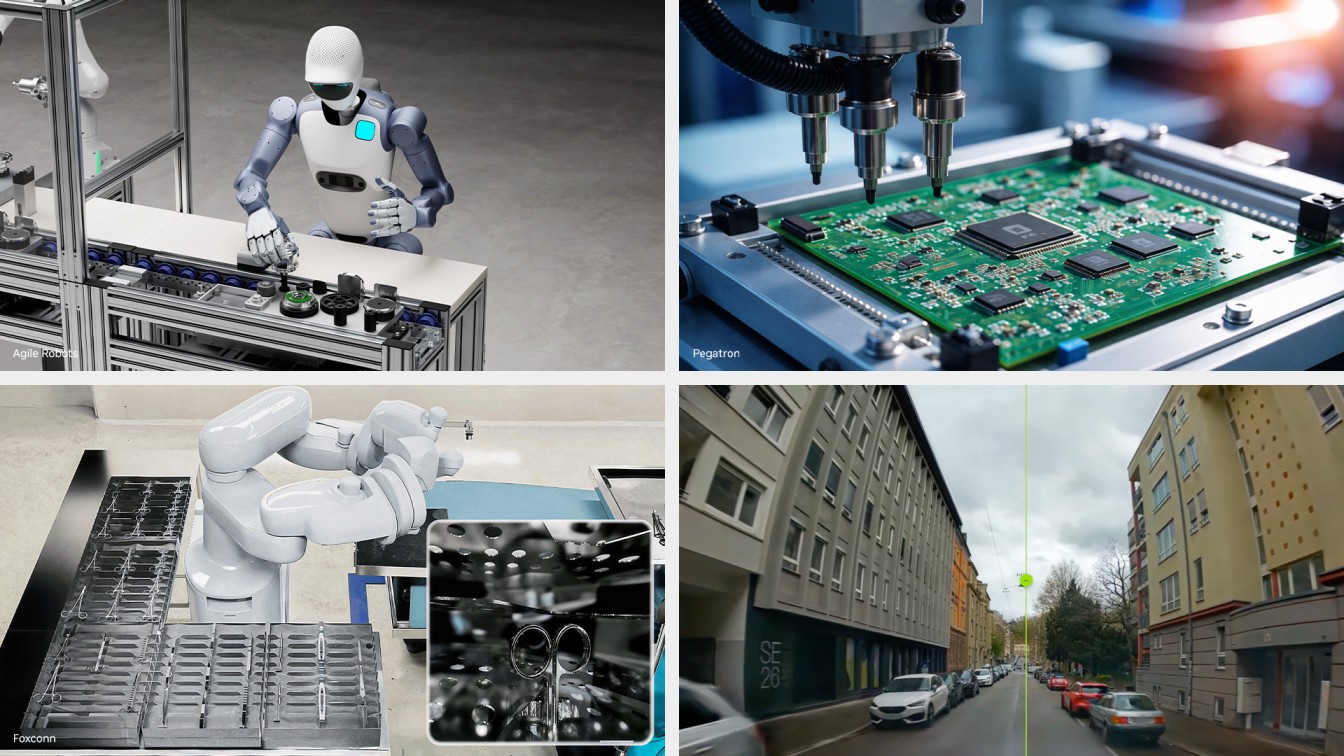
- Industry leaders including Agile Robots, Cadence, Dassault Systèmes, Delta Electronics, Foxconn, Pegatron, PTC, Siemens, Synopsys and TSMC are using NVIDIA physical AI tools to accelerate physical AI development.
NVIDIA announced a major collection of open source physical AI skills and tools that help developers turn complex robotics, autonomous vehicle (AV), vision AI and industrial digital twin workflows into agent-executable tasks — reducing the costs, time and complexity of building physical AI workflows at scale.
As AI agents move from writing code to orchestrating entire development tasks, physical AI is the next frontier. NVIDIA physical AI skills, available as part of NVIDIA Agent Toolkit, let agents use NVIDIA libraries, models and frameworks to speed the data generation, simulation, training, evaluation and deployment pipelines behind robots, AVs, factories and labs.
“AI agents are revolutionizing software development, and that shift is now coming to physical AI, extending into the systems that will transform transportation, manufacturing, healthcare and robotics,” said Jensen Huang, founder and CEO of NVIDIA. “When agents can directly use NVIDIA libraries, models and frameworks, physical AI development will move faster, enabling developers to build the robots, autonomous vehicles and industrial systems of the future at an incredible pace.”
Agent-Ready Tools and Skills for Physical AI Development
NVIDIA is optimizing its entire physical AI stack for agents by turning libraries, models and frameworks into agent-callable tools. This includes NVIDIA Cosmos™ world foundation models for physical world reasoning and generation, NVIDIA Omniverse™ libraries for simulation and digital twins, NVIDIA Isaac™ for robotics simulation and robot learning, NVIDIA Metropolis for vision AI, NVIDIA Alpamayo for autonomous driving and the NVIDIA Jetson™ platform for edge AI development.
To help developers apply these tools, NVIDIA is launching new skills as part of NVIDIA Agent Toolkit to turn physical AI development processes into repeatable instructions that coding agents can follow. This includes which tools to call, what outputs to produce and how developers can validate results.
Developers can also safely build and deploy autonomous agents using these skills with the NVIDIA NemoClaw™ blueprint and the NVIDIA OpenShell™ runtime, which provides policy-based security and privacy governance on local or cloud hardware.
NVIDIA physical AI skills and tools are accelerating agentic development across:
- Robotics and edge AI: Robot developers can use skills to accelerate the entire robotics development pipeline, from generating perception and mobility training data to simulation, automating navigation training, advancing robot learning and tuning Jetson-based edge systems for deployment.
- Autonomous vehicles: For AV developers, skills can direct agents to reconstruct data captured by fleets into simulation environments, generate photorealistic driving scenarios at scale and run closed-loop reinforcement learning to expand training and evaluation coverage.
- Real-time vision AI agents: For automated inspection and video intelligence, agent skills help teams generate synthetic training data, fine-tune models, automate labeling and build video AI agents that search, summarize and analyze live or recorded video.
- Industrial AI: Industrial software developers can use these skills to convert engineering data into computer-aided design (CAD) assets for digital twin simulation, optimizing large OpenUSD scenes with less manual setup.
- Healthcare: Before deploying automation in clinical environments, healthcare teams can guide agents through hospital-environment digital twin creation, sim-to-real data generation and software-in-the-loop policy testing.
The skills can be combined and integrated into larger agentic systems, enabling developers to orchestrate and automate complex workflows such as data generation, simulation, optimization, inference tuning, continuous evaluation and more.
Industry Leaders Build With NVIDIA Physical AI Technologies
Industry leaders across manufacturing, autonomous vehicles, healthcare and industrial software are using NVIDIA physical AI libraries to advance the development of autonomous systems and industrial AI.
As these libraries become agent-ready, developers can use NVIDIA skills to help agents automate setup, execution and iteration across complex physical AI workflows.
In electronic manufacturing, TSMC and Pegatron are fine-tuning visual inspection models. Pegatron reduced model training and deployment time by 67% using synthetic data generated from the Defect Image Generation skill.
Delta Electronics generated synthetic defect data and used the skill to catch excess soldering on metal busbars, improving detection rate by 17%. Inventec developed its Observation Agent visual inspection pipeline by integrating the Defect Image Generation skill, reducing defect data collection effort for laptop chassis manufacturing by 30%. Foxconn, working with DeepHow, used the skill to improve manufacturing efficiency by catching errors early, boosting first pass yield by about 3%.
For autonomous vehicles, Li Auto, Afari and DeepRoute.ai are using NVIDIA Omniverse NuRec models for neural scene reconstruction and rendering, generating 1,000+ reconstructions and more than 300,000 renders and simulations per day. In addition, they are using the new agent skills repository to accelerate and enhance their development of safer, more capable autonomous driving systems.
In industrial AI, Cadence, Dassault Systèmes, Siemens and Synopsys are using NVIDIA Omniverse libraries and skills for engineering data inspection, simulation and interactive digital twins. PTC, MetAI and Lightwheel are tapping the NVIDIA Isaac Sim™ framework and OpenUSD-based workflows to transform CAD data into simulation-ready assets and environments. As part of its Autonomous Fab 2030 roadmap, SK hynix is implementing semiconductor fab digital twins using NVIDIA Omniverse, and collaborating with NVIDIA and SK Telecom to validate NVIDIA Agent Toolkit for manufacturing-specific physical AI.
1x, Agile Robots, Agility, FieldAI, Hexagon Robotics, NEURA Robotics, Skild AI and Universal Robots are among the robotics leaders using NVIDIA’s agent-ready physical AI stack to accelerate robotics development from data generation to deployment.
Foxconn and Compal are using NVIDIA Isaac for Healthcare to accelerate hospital robotics. Foxconn is scaling Nurabot across several hospitals and long-term care environments, bringing AI-powered robotics to patient care, as well as introducing its new Scrub Nurse Collaborative Robot to help optimize operating room workflows. Compal is advancing the development process of its PolyMedX robot toward a hospital-wide orchestration platform, integrating simulation, AI and real-world operations.
Availability
NVIDIA physical AI agent tools and skills are now openly available through GitHub and skills.sh for use with any coding agent.
Agent skills and tools for synthetic data generation — Neural Reconstruction, Video Augmentation, Defect Image Generation — are also available to try instantly on NVIDIA Brev as Physical AI Launchables, preconfigured environments that bundle agent skills and tools for faster synthetic data generation and evaluation.
Microsoft, CoreWeave and Nebius are integrating these agent skills and tools with their cloud services to enable developers to streamline and scale synthetic data generation and deployment.