Benewake Introduces NOVA20 LiDAR for Near-Field Safety in Embodied Robotics
The lightweight, 20-point solid-state LiDAR delivers real-time proximity measurements from 5 cm to 1 m to support collision avoidance and human-robot safety.
Image Courtesy: Public Domain
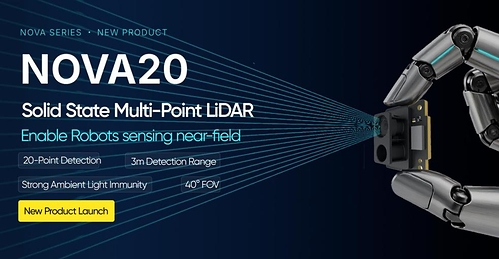
As embodied AI rapidly advances from digital reasoning to real-world physical interaction, near-field safety has become a critical requirement for commercial deployment. To address the close-range perception challenges faced by vision-centric robotic systems, Benewake is bringing its NOVA20 solid-state near-field multi-point LiDAR to embodied robotic platforms. Designed as a dedicated physical ranging layer, NOVA20 delivers real-time distance measurements across the critical 5 cm-to-1 m zone around the robot body, helping establish a reliable proximity-sensing boundary for motion and physical interaction.
Near-Field Safety Challenges in Embodied Robotics
Conventional perception architectures face several constraints in close-quarters operation:
- Uncertainty and Latency in Vision and AI: High-level VLA models rely on probabilistic inference and may introduce processing latency, limiting their ability to deliver consistent real-time input for pre-collision safety.
- Self-Occlusion in Centralized Systems: Head- and torso-mounted sensors can be obstructed by articulating limbs, torso rotation, or manipulated objects, creating blind zones around the robot's sides and lower body.
- Reactive Nature of Contact Sensing: Tactile sensors and joint torque sensing primarily respond once contact or external force occurs, providing reactive protection rather than enabling proactive, pre-contact deceleration.
- Crosstalk in Array-Based Sensors: Common 3D array solutions generally struggle with crosstalk from highly reflective surfaces—a strong return can bleed into neighboring channels and merge with the real scene, producing false obstacle readings that undermine the reliability of near-field perception.
NOVA20 Architecture and Embodied Integration
NOVA20 focuses on ranging within the 5 cm-to-1 m zone around the robot, complementing tactile sensing within 5cm and cameras or 360° LiDAR for medium- to long-range perception. It is not intended for fine dexterous grasping or force control.
- Compact, Distributed Deployment: Weighing less than 5g and consuming less than 1W, NOVA20 features a solid-state design and can be deployed on the chest, wrists, ankles, and other locations to extend proximity coverage around moving parts.
- Array-Based Spatial Detection: A 20-point detection array and 40° field of view cover the target 5 cm-to-1 m range, while stable ranging under ambient light up to 100 klux supports operation in strong outdoor sunlight.
- Crosstalk-Free Channel Readout: To eliminate crosstalk, NOVA20 uses time-division multiplexing with channel-by-channel readout, so every echo lands only in its own channel and the true scene is reconstructed as a few clean points. With false signals removed, robots no longer brake or detour for obstacles that do not exist, making the sensor far more trustworthy in tasks that cannot tolerate misjudgment, such as edge-following.
- Direct Distance Output: NOVA20 outputs physical distance data rather than 2D images, helping reduce privacy concerns in human-centric environments while lowering host-level vision processing requirements.
Core Applications and Safety Value
- Ground Edge and Drop-Off Detection: Detects negative obstacles and edges near the feet to reduce the risk of stepping into drop-offs.
- Limb and Body-Side Collision Avoidance: Monitors nearby obstacles around moving limbs and body sides to help prevent unintended contact.
- Human-Robot Proximity Safety: Provides distance inputs for pre-contact deceleration and SSM-related safety strategies.