ABZ Innovation on Scaling European Drone Manufacturing, Precision Automation and Global Growth
02 October 2026 | Interaction | By Editor Robotics Business NEWS <editor@rbnpress.com>
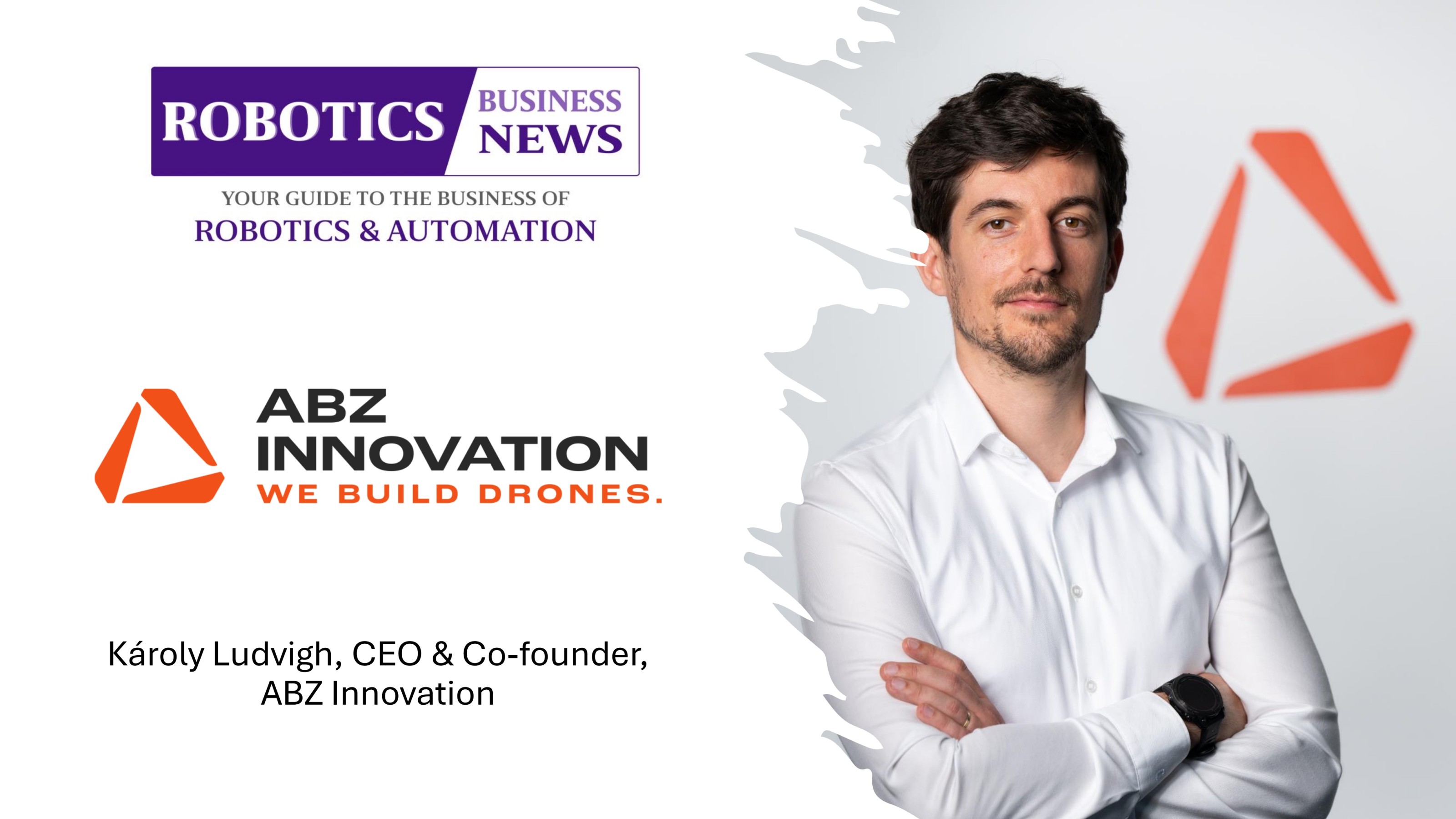
In conversation with Robotics Business News, Károly Ludvigh, CEO & Co-founder, ABZ Innovation, discusses production expansion, autonomous drone applications, sustainability and international growth.
Robotics Business News speaks with Károly Ludvigh, CEO & Co-founder of ABZ Innovation, about the company’s strategy to scale European drone manufacturing and expand its presence across global civilian drone markets. The conversation explores ABZ Innovation’s new Szentendre facility, which is being developed as a global production hub, as well as the manufacturing, supply-chain and workforce challenges associated with rapidly increasing production volumes while maintaining quality and traceability.
Ludvigh also discusses how ABZ Innovation is applying drone automation across agriculture and industrial operations, from precision spraying and reduced resource consumption to industrial cleaning at height. He explains the company’s shared technology architecture across its L-, S-, C- and M-Series platforms, its focus on autonomy and data sovereignty, and its priorities following the €7 million investment round as ABZ Innovation strengthens its international distribution, service network and next-generation civilian drone capabilities.
What was the strategic vision behind making the new Szentendre facility ABZ Innovation's global production hub, and how will it support your international growth?
We didn't start out as a factory — ABZ Innovation began by building drones by hand, learning as we went. The Szentendre site is the first facility we've had that was actually built for what we do, rather than adapted to it. It's roughly four times the floor space of our previous site, and that isn't about scale for its own sake — it's about having the process control to manufacture at the volume our international growth now requires, without compromising precision. Everything is produced in one location, under EU standards, with full traceability. That is what lets a customer anywhere in the world trust the same drone that's flying here in Hungary.
With production targeted to triple in 2026 and double again in 2027, what are the biggest manufacturing and supply-chain challenges you expect as ABZ Innovation scales?
Equipment and floor space are, relatively speaking, the straightforward part — you can plan for those. The harder challenge is scaling people and training fast enough that quality control doesn't slip as volume increases. On the supply side, we've made a deliberate effort to bring critical components in-house rather than depend on outside vendors — our own battery platform is a good example, developed specifically so we're not exposed to someone else's supply chain or pricing. It takes longer to build that way, but it means we control our own timeline.
ABZ Innovation's drones are now deployed in more than 40 countries. What are the key factors driving demand for heavy-duty civilian drones across agriculture and industrial applications?
There are a few factors that come up consistently across the markets we sell into, in both agriculture and industry. Efficiency is the first — a drone covers a field or a structure far faster than manual methods, and does it the same way every time. Operating cost follows directly from that: fewer labor hours, less equipment overhead, and on the agricultural side, meaningfully lower input use per hectare, which shows up on a farm's bottom line immediately. Safety matters just as much — precision spraying and industrial cleaning at height both carry real risk when done manually, and taking the operator out of that risk isn't a secondary benefit, it's central to why customers switch. European build quality, full data sovereignty and the after-sales support behind the equipment give operators confidence that what they're buying will still be performing years from now. Labor availability plays into this too — several of our markets simply can't find enough skilled people for this kind of work — and once an operator sees the consistency a drone delivers, regardless of who's flying it, that's usually what converts interest into a purchase.
The L-Series can reduce water usage by up to 90% and chemical inputs by up to 50%. How is ABZ Innovation using automation and precision technology to improve sustainability in agriculture?
Precision starts with the spraying method itself. Our CDA system, combined with downward airflow control, already delivers those reductions — up to 90% less water and up to 50% less chemical use compared with conventional methods — across a full-field application, before data even comes into it. On top of that baseline, we can optimize further with spot and differential application — targeting input to specific zones, or even individual plants, based on field data rather than treating the whole area the same way. So there are really two layers to it: efficient application technology that saves substantially on its own, and data-driven targeting that pushes the savings further still. Either way, lower input cost for the grower and lower environmental impact come from the same engineering decision.
The C-Series is becoming one of your fastest-growing product lines. What is driving the shift toward drone-based industrial cleaning, and where do you see the largest opportunities?
Cleaning at height has always meant scaffolding, and scaffolding carries real drawbacks on every front. On timeline, it takes days to assemble and dismantle before the actual cleaning even begins; the C10 deploys immediately and completes the same job in hours. On safety, scaffolding puts people at height, with all the liability that comes with it; our crews work entirely from the ground. On reach, scaffolding is constrained by the structure itself; the drone handles silos, towers and wind turbines with the same ease as a façade. And the infrastructure required is minimal — no heavy labor force, no physical footprint, just flight permits and a certified pilot. Together, that adds up to a meaningfully lower total cost per project and a much faster turnaround, which is exactly what's pulling industrial operators toward drone-based cleaning. The largest opportunity we see ahead is interior cleaning of large industrial halls and warehouses — a space scaffolding was never well suited for, and one where demand is already building fast.
With the L-, S-, C-, and M-Series serving different applications, how do you decide where to invest in new drone capabilities, autonomy, and AI?
All four series — the L-Series for precision spraying, the S-Series for granule and seed spreading, the C-Series for industrial cleaning, and the M-Series as our open multifunctional platform — are built on the same underlying architecture: the same flight controller, the same software stack, the same core hardware. That shared foundation is what actually gives us our flexibility. When a new market need emerges, we aren't starting from zero — we adapt an existing platform, which takes months rather than years. So the decision really comes down to market pull: if there's real demand, we build it, because we have the platform to do it quickly and efficiently.
ABZ Innovation emphasizes European manufacturing, data sovereignty, and professional after-sales support. How important are these factors for customers operating mission-critical civilian drone systems?
Our customers are running farms and industrial operations — this equipment is part of how they generate revenue, not a discretionary purchase. European manufacturing gives them confidence in build quality and regulatory compliance. Full data sovereignty — offline operation, no cloud dependency — matters increasingly to institutional customers who won't accept their operational data leaving Western jurisdiction. And after-sales support is ultimately what determines whether a fleet is still performing reliably two or three years after purchase: real training, real spare-parts availability, service that responds promptly. We built that infrastructure because we're supporting an operational relationship over years, not selling a piece of hardware once.
Following the €7 million investment round, what are ABZ Innovation's key priorities for international market expansion, product development, and becoming a leading European civilian drone platform?
The round closed in January, backed by two international investors and one Hungarian investor, and it allows us to pursue three priorities in parallel rather than sequentially: bringing the new facility up to full capacity, continuing product development across the platform, and strengthening our distributor and service network in the markets where demand is accelerating fastest. We are not trying to be the loudest name in the industry. We aim to be the manufacturer operators can rely on for years to come - especially when a drone has been through a demanding season in the field and a replacement part is needed quickly.